
Buying a truckload liquidation lot is one of the fastest ways to scale a resale business, and one of the fastest ways to get burned if you skip the basics. The biggest mistakes happen between “Sounds like a great deal” and “The truck is at my dock.” This checklist walks you through that gap, from quote to delivery, with the exact checkpoints that protect your margins, your time, and your cash flow.
If you’re newer to bulk buying, you may also want to skim this deeper guide first: How to buy truckloads safely. Then come back here and use this as your step-by-step operating checklist.
Before you request a quote: define your truckload “win condition”
Most quote conversations fail because the buyer and supplier are solving different problems. You are trying to buy profit, predictable processing time, and sell-through. A supplier is trying to move volume efficiently. Aligning expectations up front makes the rest of the process smoother.
Checklist: your business constraints (write these down)
- Receiving setup: dock-high door, forklift available, pallet jack, liftgate needed, limited access (residential, storage unit, narrow street), appointment required.
- Space: how many pallet positions you can store immediately (and how many you can process per week).
- Labor reality: who sorts, tests, cleans, lists, and how many hours per pallet you can afford.
- Sales lanes: where you will sell (local marketplace, flea market, your website, eBay, Amazon, B2B).
- Category fit: what you can actually move in your market (tools, home goods, apparel, general merchandise, electronics).
- Risk tolerance: returns/open-box versus salvage, tested versus untested.
If you are still building your cost model, this guide helps you avoid “profit on paper” mistakes: Liquidation business basics: costs, permits, and profit math.
Step 1: Quote request checklist (what to ask, in plain English)
A truckload quote is not just “price + shipping.” You are buying a bundle of assumptions. Your job is to turn assumptions into confirmed details.
Checklist: minimum details to request
- Lot type: returns, shelf pulls, overstock, mixed condition, salvage.
- Estimated pallet count or truckload configuration (how it’s loaded).
- General categories included and what categories are excluded.
- Manifest availability and what it represents (units, SKUs, MSRP, estimated retail, or just a category summary).
- Condition notes (new, open-box, used, damaged packaging, untested, missing parts).
- Photos of the actual load or representative pallets.
- Shipping terms: who arranges freight, what address type is required, appointment rules.
- Lead time: how soon it ships after payment.
- Claims policy: what happens if there is clear shipping damage or a major mismatch.
A simple way to keep your supplier conversations consistent is to use the same question set every time. This article gives a ready-to-use version: What to ask before you buy.
Step 2: Evaluate the quote using landed cost (not just load price)
Many first-time truckload buyers compare quotes based on load price alone, then discover that freight, handling, and shrink turn a “deal” into a break-even.
Landed cost formula you should use
Landed cost = product cost + freight + receiving costs + processing costs + disposal/returns costs + fees.
Even if you don’t track every penny, you should estimate it before you buy.
Table: common truckload liquidation cost line items
| Cost bucket | What it includes | Why it matters |
|---|---|---|
| Product cost | Truckload price, any buyer premium, payment fees (if applicable) | Your base cost per pallet or per unit starts here |
| Freight | Linehaul, fuel surcharge, liftgate, appointment fee, limited access, re-delivery | Freight surprises are a top margin killer in truckload liquidation |
| Receiving | Forklift rental, labor to unload, check-in time, pallet count verification | If you cannot receive efficiently, processing backs up immediately |
| Processing | Sorting, testing, cleaning, repackaging, labeling, listing | This is often the biggest hidden cost in returns-heavy loads |
| Shrink and disposal | Missing items, unusable goods, trash fees, e-waste handling | Salvage-heavy loads can require real disposal planning |
| Selling fees | Marketplace fees, payment processing, shipping supplies | Determines true net profit, not just gross margin |
If you are still deciding whether pallets or truckloads fit your stage, use this comparison: Pallets vs truckloads for resellers.
Step 3: Manifest and condition checklist (how to avoid buying mystery inventory)
A manifest can be helpful, but only if you treat it as a planning tool, not a promise. Your goal is to estimate resale value, labor, and risk.
Checklist: how to read a manifest like an operator
- Check what “value” means: MSRP, retail, or estimated. These are not the same.
- Scan for restricted items for your channels (especially if you sell on Amazon).
- Look for labor signals: complex products, missing-part risks, lots of small accessories, fragile items.
- Watch for hazmat and battery-heavy products if you ship items later.
- Spot “silent killers”: high return categories (certain consumer electronics), items that require testing, items with high defect rates.
If your loads include electronics, read this before you commit, it can save you from the most common loss patterns: Liquidation electronics: what to buy and what to avoid.
Step 4: Freight and delivery checklist (prevent the day-of chaos)
Freight is where truckload deals go sideways. Not because freight is complicated, but because it is precise. A wrong assumption about delivery site type or equipment can trigger delays and fees.
Checklist: confirm delivery site facts
- Business address vs residential: carriers price and schedule differently.
- Dock-high available: if not, confirm liftgate service.
- Forklift or pallet jack: confirm you can move pallets off the truck and into storage.
- Access constraints: low bridges, narrow streets, gate codes, limited access hours.
- Appointment policy: some sites require scheduled appointments, confirm who sets it.
- Receiving contact: name and phone that will answer when the driver calls.
If you are deciding between local pickup and freight delivery for bulk buys, this breakdown helps you plan the true trade-offs: Pickup vs freight delivered pallets.
Checklist: documents you should have before the truck arrives
- Invoice/receipt showing what you paid and what you bought.
- Bill of lading (BOL) details, including shipper and consignee.
- Load description: pallet count and any key notes (mixed condition, returns, etc.).
- Manifest (if provided).
- Claims process instructions (who to contact, time window).
Step 5: Receiving day checklist (how to inspect without slowing down the driver)
You usually do not have time to open and audit the whole load at delivery. But you do have time to do a “dock audit” that protects you if there is clear shipping damage or a major mismatch.
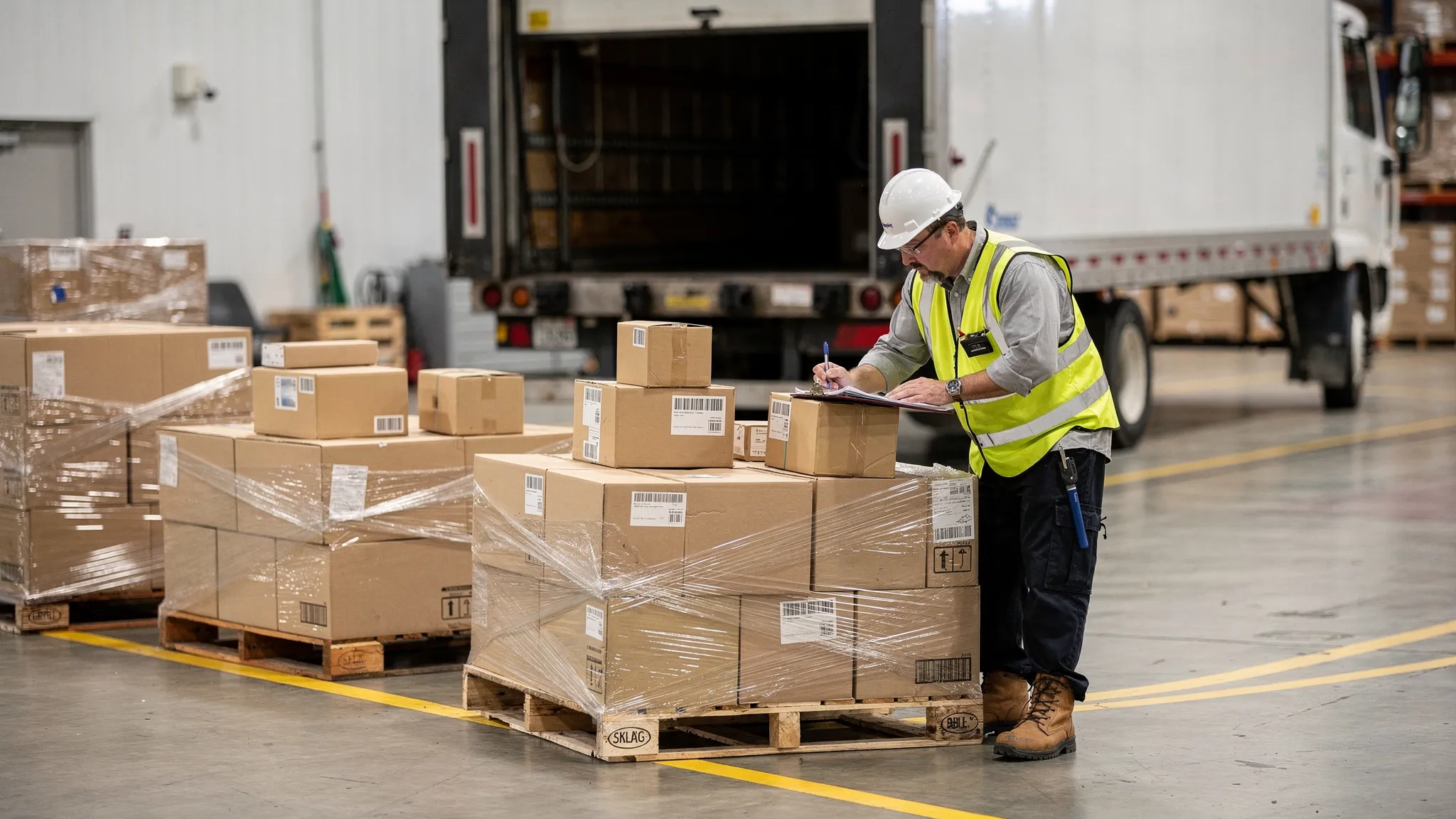
Checklist: quick dock audit in under 20 minutes
- Count pallets and compare to paperwork.
- Take time-stamped photos of:
- the trailer before unloading (if possible)
- each side of the pallets after unloading
- any crushed corners, broken wrap, tipped pallets, or water exposure
- Look for obvious exceptions: missing pallets, visibly different categories than described, significant water damage.
- Note it on the BOL before signing if something is clearly wrong.
Practical rule: if you see damage, document it immediately. If you do not document it at delivery, your leverage later is usually weaker.
Step 6: Post-delivery verification (first 24 hours)
Once the driver is gone, your real work starts. The first 24 hours should focus on confirming what you bought and preventing the load from becoming a disorganized pile that drains labor.
Checklist: your first 24-hour workflow
- Create a receiving ID for the load (date + supplier + category).
- Label pallet positions (even a simple A1, A2 system).
- Separate into three processing lanes:
- quick list / quick sell items
- needs testing or parts check
- salvage or disposal candidates
- Pull and quarantine risky categories (batteries, sharp tools, recalled items if suspected).
- Sample audit: open a small set of boxes across multiple pallets to validate condition assumptions.
This is also where you should decide, quickly, what your primary exit strategy is for the load. If your load includes Amazon-origin goods or you sell on Amazon, review this guide to avoid common restrictions and margin traps: Amazon pallets explained: conditions, manifests, and margins.
Step 7: Profit protection checklist (your “max buy” reality check)
Even after you’ve purchased, you can protect your cash by making fast decisions on pricing and routing. The most expensive truckloads are the ones you process too slowly.
Checklist: the three numbers to calculate immediately
- All-in cost per pallet: landed cost divided by pallet count.
- Target recovery rate: the percentage of “value” you realistically expect to recover through sales, after defects and losses.
- Processing hours per pallet: a realistic estimate, based on what your team can do weekly.
If you have trouble estimating recovery rate, use comparable category guidance. For example, tools and hardware are often easier to sell locally if you can verify function and completeness, this guide shows how resellers price tool lots for speed: How to price tool lots for quick turn.
Common truckload liquidation mistakes (and the prevention step)
These are patterns that show up repeatedly with truckload liquidation deals.
You bought a category you cannot process
A load can be profitable in theory and still be wrong for your operation. For example, untested electronics can consume labor fast. Prevention is matching lot type to your testing capacity and sales lanes, not just chasing a low price.
You underestimated freight complexity
Liftgate, limited access, appointment scheduling, and re-delivery fees can erase your margin. Prevention is confirming address type and receiving equipment before you pay, and getting freight terms in writing.
You had no plan for salvage and disposal
If the lot includes low-value items, broken items, or unusable inventory, you still have to move it, store it, and dispose of it legally. Prevention is setting a salvage lane immediately and planning disposal options.
You did not track what worked
Truckload buying gets easier when you track outcomes by lot type and supplier, including sell-through, recovery rate, and processing time. Prevention is creating a simple spreadsheet for every load and measuring the same metrics each time.
A quick note on stress and decision fatigue (yes, it affects buying)
Scaling a resale business can be stressful, especially when you start buying larger liquidation truckloads and your cash is tied up in inventory. Decision fatigue can lead to rushed buys, skipped freight checks, and poor inventory routing.
If you notice anxiety, depression, or attention issues affecting your operations or focus, consider getting professional support. For readers based in New York City, comprehensive psychiatric services in NYC can be one option to explore.
Where American Bulk Pallets fits into this checklist
American Bulk Pallets is built for resellers buying in volume, offering wholesale liquidation pallets and direct truckload sourcing with manifests, nationwide shipping, and support that helps you plan before you buy.
If you’re ready to move from browsing to buying, here are the most useful next steps:
- Review your supplier questions using the checklist in What to ask before you buy.
- If you’re comparing options by location and shipping, use How to compare wholesale pallet suppliers.
- Explore available lots and request a quote through American Bulk Pallets.
The goal is simple: treat truckload liquidation like a repeatable process, not a gamble. When you do that, buying bigger becomes less risky, and a lot more profitable.