
Buying liquidation pallets is not hard. Buying the right liquidation pallets for your business model is where the money is made (or lost).
In 2026, returns and overstock continue to fuel the liquidation market. The National Retail Federation has reported that U.S. retail returns are measured in the hundreds of billions of dollars annually, which is why pallets and truckloads keep flowing from major retailers into secondary markets like yours.
This guide breaks down three things resellers ask for most:
- Grades (condition categories) and what they really imply
- Load types (pallets vs truckloads) and how to choose
- Real profit examples (clearly labeled) so you can sanity-check deals fast
1) Liquidation pallet grades: the truth is they are not standardized
One supplier’s “Grade A” can look like another supplier’s “Grade B.” Some sellers grade by cosmetic condition, others by functionality, and some by packaging. Your job is to translate the grade into two business realities:
- Recovery rate: how much sellable value you can realistically pull out
- Processing cost: labor, testing, cleaning, parts, and disposal
A solid supplier will be transparent about the source (returns, shelf pulls, overstock), provide a manifest when available, and explain what their grade labels mean.
If you want a deeper manifest and grading walkthrough (especially for big-box loads), see: Pallets Target Buyers Guide: Manifests, Grades, and Risks.
Common condition buckets you will see (and how to think about them)
Below is a practical “translation chart” that works across most retailers and categories.
| What sellers call it | What it usually means | Typical reseller workload | Best-fit resale lanes |
|---|---|---|---|
| New / Overstock | Unused items, often excess inventory | Low (count, inspect packaging) | Amazon (if eligible), eBay, Shopify, wholesale bundles |
| Shelf pull / Store pull | Pulled from shelves, often packaging wear | Low to medium (inspect, re-bag, label) | eBay, local marketplace, flea market |
| Open-box | Opened, may be missing accessories, may be unused | Medium (verify completeness, test when relevant) | eBay, local, “open-box” listings |
| Customer returns | Returned for many reasons, condition varies widely | Medium to high (triage, test, recondition) | eBay, local, flea market, parts lots |
| Salvage / As-is | Damaged, incomplete, or untested, often not retail-ready | High (parts, repair, scrap, disposal) | Parts/repair, wholesale, recycling streams |
Two fast takeaways:
- Customer return is a source label, not a grade. For Amazon-origin loads, this is a frequent misunderstanding. Related reading: Amazon Pallets Returns: What “Customer Return” Really Means.
- Salvage can still be profitable, but only if you have a plan for parts, repair, or bulk disposal. Beginners usually burn cash here.
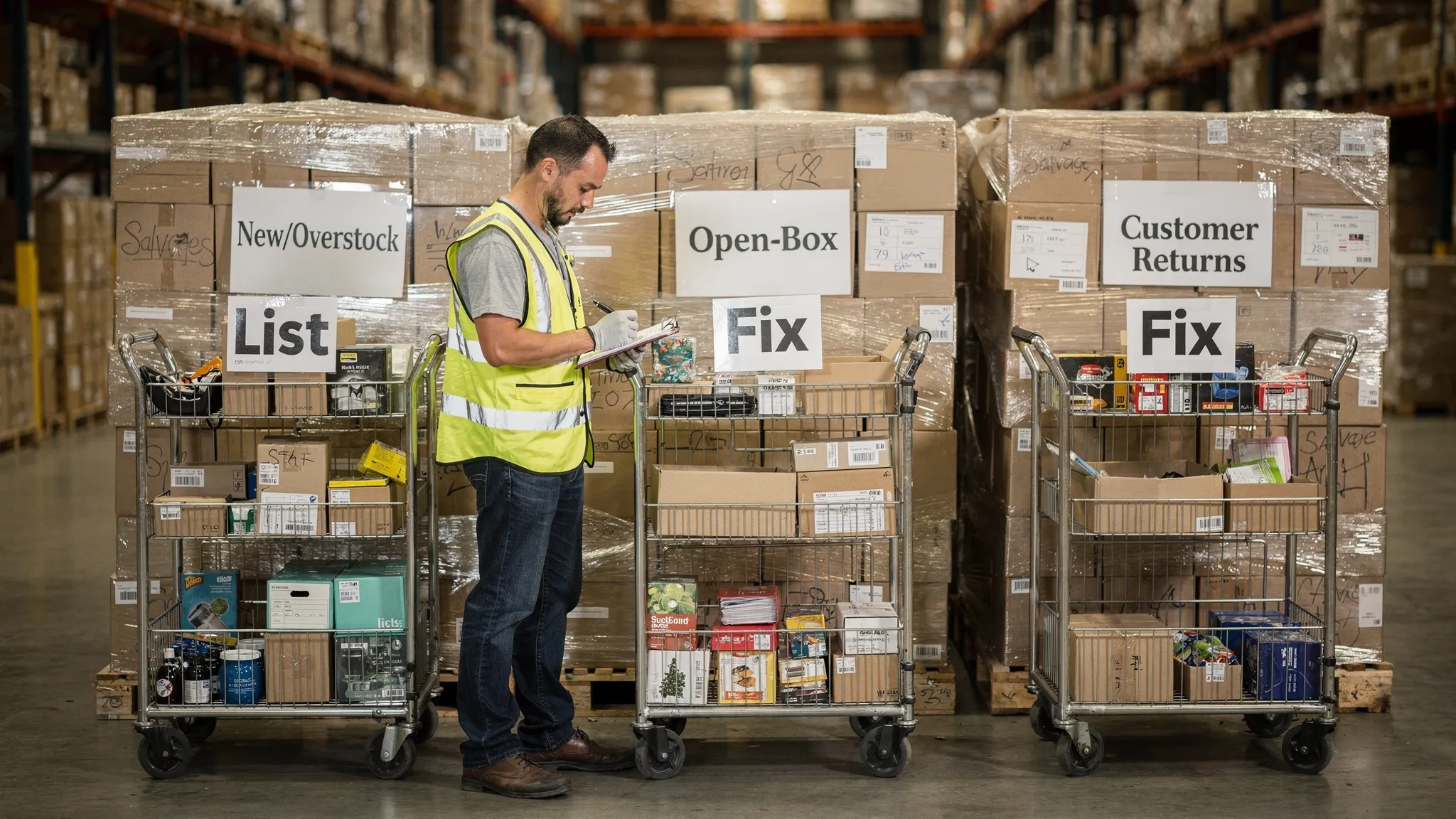
“Grade A/B/C” cheat sheet (use this to ask better questions)
Many liquidation sellers use a letter grade system. Here is a helpful way to interpret it, while still confirming the supplier’s exact definitions.
| Letter grade (common) | What buyers often expect | What you should verify before you buy |
|---|---|---|
| A | Mostly new-like, minimal issues | Is it tested or just clean? Any missing accessories allowed? |
| B | Usable with minor defects or packaging damage | What % is open-box vs returns? What are the top 3 defect types? |
| C | Heavier wear, missing parts more common | Is it priced for parts value? Any restrictions (hazmat, recalls)? |
| D / Salvage | As-is, untested, broken, incomplete | What is disposal risk? Any electronics battery risk? Any returns on claims? |
If you buy electronics, condition definitions matter even more. A dedicated guide: Liquidation Electronics: What to Buy and What to Avoid.
2) Loads: pallet, partial, or truckload, what changes (besides price)
“Load size” is not just about spending more money. It changes your freight, storage, labor, and the kind of inventory you can absorb.
Pallets (best for testing a model)
A liquidation pallet is the most controlled way to start building data:
- Faster learning loop (you find out what your real recovery rate looks like)
- Easier storage (garage, small storage unit, small warehouse)
- Lower freight risk (still important, but easier to absorb)
If you are comparing pickup vs freight delivery, this helps: Liquidations Near Me: Pickup vs Freight Delivered Pallets.
Half truckloads and full truckloads (best when you have repeatable operations)
Truckloads can be the difference between a hobby and a scalable business, but they punish weak workflows.
Truckload buyers usually win because they have:
- A sorting workflow that moves inventory in 24 to 72 hours
- Multiple exit lanes (online, local, wholesale, parts)
- Space and equipment (dock or liftgate plan, pallet jack, racking)
If you want a step-by-step buying and receiving process, use: Truckload Liquidation Checklist: From Quote to Delivery.
Manifested vs unmanifested loads
Manifests can help you estimate value, but they are not a guarantee. The key is to treat the manifest like a forecast and price in error.
A practical rule: assume some mismatch (missing accessories, substitutions, or condition variance), then only buy if the deal still works.
For a fuller breakdown of how to evaluate this, see: Pallets Store Guide: What to Ask Before You Buy.
3) Profit math that keeps you honest (the 4 numbers that matter)
Before you look at any “% off retail,” lock in these four numbers:
- Total landed cost = inventory cost + freight + unload/receiving supplies
- Recovery rate = dollars you can realistically sell (not retail, not “listed price”) divided by total landed cost
- Sell-through speed = how quickly you convert inventory to cash
- True net margin = profit after fees, refunds, packaging, and shrink (and labor if you pay it)
The simplest deal screen (quick formula)
Use this to avoid emotional buying:
Expected profit = (Expected sales revenue) − (Total landed cost) − (Selling costs)
Selling costs include marketplace fees, payment processing, shipping subsidies, returns, and basic supplies.
4) Real profit examples (hypothetical, but realistic frameworks)
These examples are not promises. They are models you can copy, using your own numbers.
Example A: Mixed general merchandise pallet (beginner-friendly)
Assume a manifested pallet with mostly home goods, small appliances, and soft goods.
| Item | Amount (example) |
|---|---|
| Pallet purchase price | $650 |
| Freight to you | $220 |
| Supplies (labels, bags, tape) | $30 |
| Total landed cost | $900 |
| Expected sales revenue (after markdowns) | $1,650 |
| Selling costs (fees, small refunds, shipping subsidy) | $300 |
| Estimated profit | $450 |
Why this can work: the category mix gives you flexibility. You can send higher-value items to eBay and move the rest locally.
What can break it: slow-moving bulky items, missing accessories, and underestimating freight.
Example B: Open-box electronics pallet (higher margin potential, higher skill)
Assume mostly open-box accessories and small electronics (not high-risk items like cracked TVs).
| Item | Amount (example) |
|---|---|
| Pallet purchase price | $1,200 |
| Freight | $260 |
| Testing supplies (cables, batteries, cleaners) | $60 |
| Total landed cost | $1,520 |
| Expected sales revenue | $2,450 |
| Selling costs (fees, shipping, higher return rate buffer) | $520 |
| Estimated profit | $410 |
Notice the key point: revenue can be strong, but selling costs rise too (returns, shipping, testing, and time).
If you are new to electronics, read first: Liquidation Electronics: What to Buy and What to Avoid.
Example C: Full truckload (scale play) with multi-lane exit
Assume you buy a truckload and split it into three lanes: online listings, local quick cash, and bulk/parts.
| Item | Amount (example) |
|---|---|
| Truckload cost | $18,000 |
| Freight | $2,300 |
| Warehouse handling, pallets, wrap, supplies | $700 |
| Total landed cost | $21,000 |
| Online sales revenue (best items) | $18,500 |
| Local sales revenue (fast movers) | $9,200 |
| Bulk/parts revenue (remaining) | $2,800 |
| Total sales revenue | $30,500 |
| Selling costs (fees, shipping, refunds, disposal) | $5,800 |
| Estimated profit | $3,700 |
Why truckloads can win: your unit freight cost often improves, and you get enough volume to feed multiple channels consistently.
Why truckloads can hurt: one bad assumption about condition mix, storage, or labor capacity can turn “profit” into dead inventory.
If you are deciding between pallets and truckloads, this comparison is built for that: Amazon Bulk Liquidation: Pallets vs Truckloads for Resellers.
5) Match grade to the right exit lane (so you do not fight the inventory)
Profitability improves when the condition matches the channel. Here is a simple pairing guide.
| Condition | Best channels | Why it fits |
|---|---|---|
| New/overstock | Amazon (if eligible), eBay, your own site | Customers pay for “new,” less friction |
| Shelf pulls | eBay, flea market, Facebook Marketplace | Minor packaging wear is acceptable |
| Open-box | eBay, local, “open-box” bundles | Buyers expect discounts and missing packaging |
| Returns | local, eBay (honest condition), bin-store style | You can sell imperfect items with disclosure |
| Salvage | parts lots, repair techs, bulk liquidation | Monetize what is left without over-investing labor |
A good mental model is: the lower the grade, the more you should sell in bulk and locally, unless you have a dedicated refurb operation.
A quick note on sneakers and collectibles
Sometimes loads include footwear, apparel, or collectible items where pricing changes fast. If you are researching resale comps for popular sneaker models, browsing an established sneaker retailer like BigBoiSneakers can help you understand market positioning and which pairs command a premium (even if you ultimately sell in the U.S.).
6) What to ask a supplier before you buy (grade and load edition)
Instead of asking “What’s the retail value?”, ask questions that reduce surprises:
- How is this grade defined here? (packaging, functionality, completeness)
- Is the load manifested? If yes, is it unit-level and how recent?
- What is the source? (returns, shelf pulls, overstock, mixed)
- Any restricted item risks? (hazmat, recalls, missing chargers, batteries)
- What is the shipping plan? liftgate, appointment, residential limits, and how claims are handled
If you need a fast supplier legitimacy check, this is useful: Wholesale Pallets Near Me: Vetting a Warehouse in 10 Minutes.
Frequently Asked Questions
What are the grades of liquidation pallets? Most suppliers use condition buckets like new/overstock, shelf pulls, open-box, customer returns, and salvage. Some also use letter grades (A to D), but grading is not standardized, so confirm the seller’s definitions.
Are manifested liquidation pallets always better? Not always. Manifests help you estimate value and category mix, but they can be incomplete or mismatched. Buy based on conservative expected recovery, not on manifest retail totals.
How do I calculate profit on liquidation pallets? Use total landed cost (inventory + freight + supplies), estimate realistic sales revenue after markdowns, subtract selling costs (fees, shipping, refunds), and keep a buffer for unsellable items.
What is the best pallet grade for beginners? New/overstock, shelf pulls, and higher-quality open-box lots tend to be more beginner-friendly because they require less testing and reconditioning than customer returns or salvage.
Should I start with pallets or truckloads? Start with pallets if you are still learning recovery rates and building a workflow. Move to truckloads once you have space, cash-flow control, and at least two to three reliable resale channels.
Ready to buy liquidation pallets with clearer expectations?
American Bulk Pallets supplies wholesale liquidation pallets and direct truckload liquidations with product manifests provided when available, plus nationwide and international shipping and dedicated support for resellers.
Browse resources to tighten your buying process:
- Build a safer buying checklist: Pallets Store Guide: What to Ask Before You Buy
- Get truckload-ready: Truckload Liquidation Checklist: From Quote to Delivery
When you are ready to source, start at American Bulk Pallets and choose a load size that matches your processing capacity, not just your budget.