If you’re searching “wholesale pallets near me”, you’re probably trying to solve a very specific problem: find a nearby warehouse so you can inspect inventory, reduce freight costs, and start turning product quickly.
The catch is that “near me” does not automatically mean “legit” or “a good fit for your resale model.” The fastest way to protect your cash is a short, repeatable warehouse check you can do the same day you find a listing.
This guide gives you a 10-minute vetting process you can use on-site (or adapt for a video walkthrough) to decide whether a warehouse deserves your time, your truck, and your money.
What you can actually verify in 10 minutes (and what you can’t)
Ten minutes is enough to confirm the big three:
- They exist and operate like a real warehouse (not a mailbox, not a random storage unit).
- They can describe inventory clearly (source, conditions, and what paperwork you get).
- Their process is stable (receiving, staging, loading, and basic accountability).
Ten minutes is not enough to “prove profitability.” That part comes from your landed-cost math, your sell-through, and your ability to process and move inventory. If you need help with the numbers, this primer is useful: Liquidation Business Basics: Costs, Permits, and Profit Math.
Your 10-minute warehouse vetting scorecard
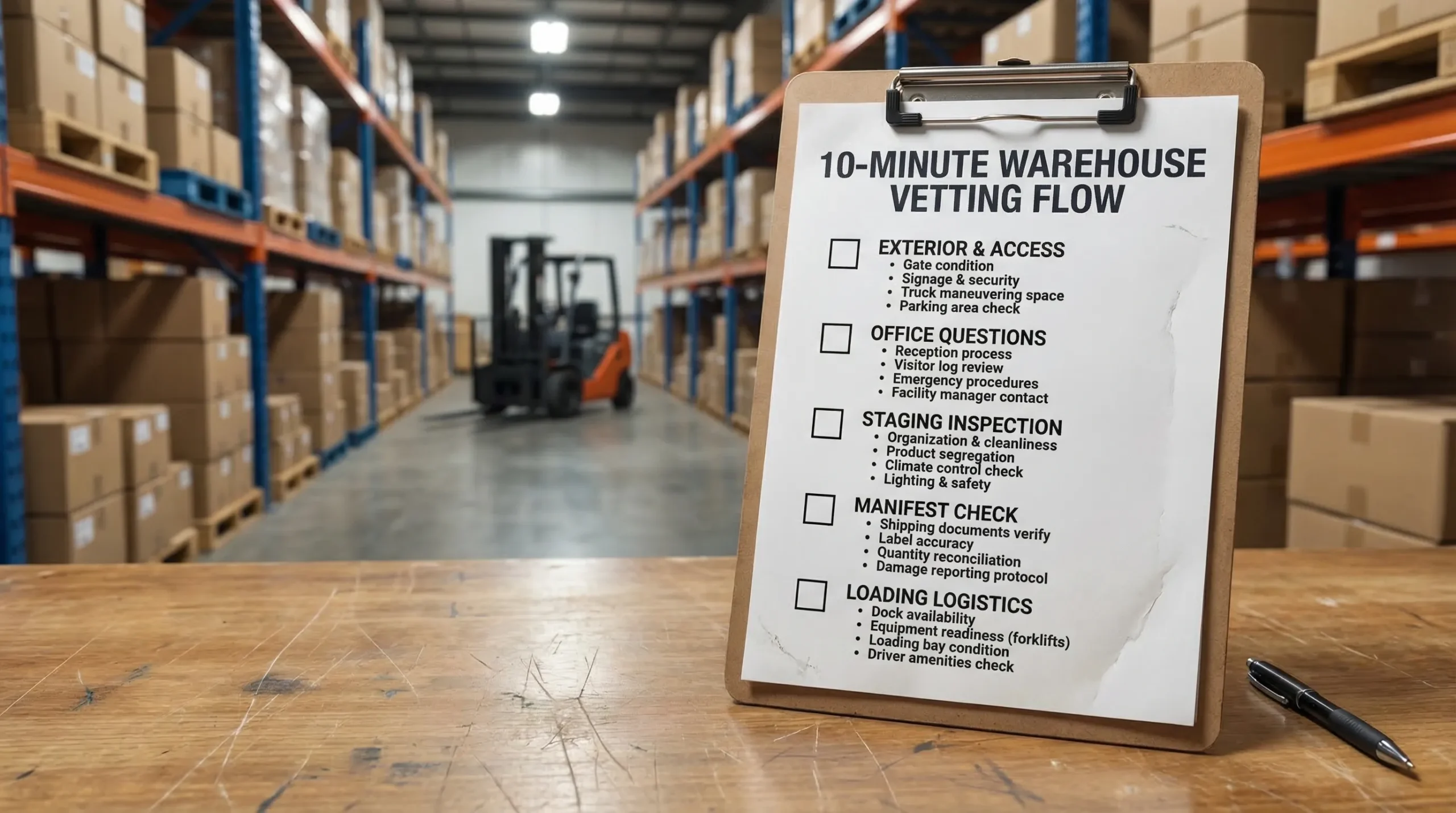
Use the table below like a checklist. You’re not looking for perfection, you’re looking for consistency.
| Minute | What to check | “Pass” looks like | Red flags | What to ask (one sentence) |
|---|---|---|---|---|
| 0 to 2 | Location and signage | Real industrial address, clear access, basic signage | Residential address, constant address changes, no loading access | “Is this your primary warehouse and where do loads arrive?” |
| 2 to 4 | Front office and professionalism | Simple intake process, invoice terms explained, staff knows grades | Confusion about pricing, pressure tactics, “cash only” vibes | “What condition grades do you sell and how do you define them?” |
| 4 to 6 | Staging and pallet integrity | Pallets wrapped, labeled, staged by category/grade | Loose product piles, mixed lots, heavy damage hidden | “Can I see one pallet that matches the manifest?” |
| 6 to 8 | Paperwork and traceability | Manifest example, clear lot ID, basic terms (as-is, claims policy) | No manifest ever, vague “MSRP” talk only, no lot identifiers | “Do your pallets come with manifests, and how often are they accurate?” |
| 8 to 10 | Loading readiness and shipping reality | Dock or forklift access, appointment rules, BOL process | “Figure it out when you get here,” no equipment, no pickup policy | “What equipment is available for loading, and what are pickup hours?” |
If you get two or more serious red flags, pause and do not “test order” out of hope. Most losses in liquidation happen when buyers ignore early signals.
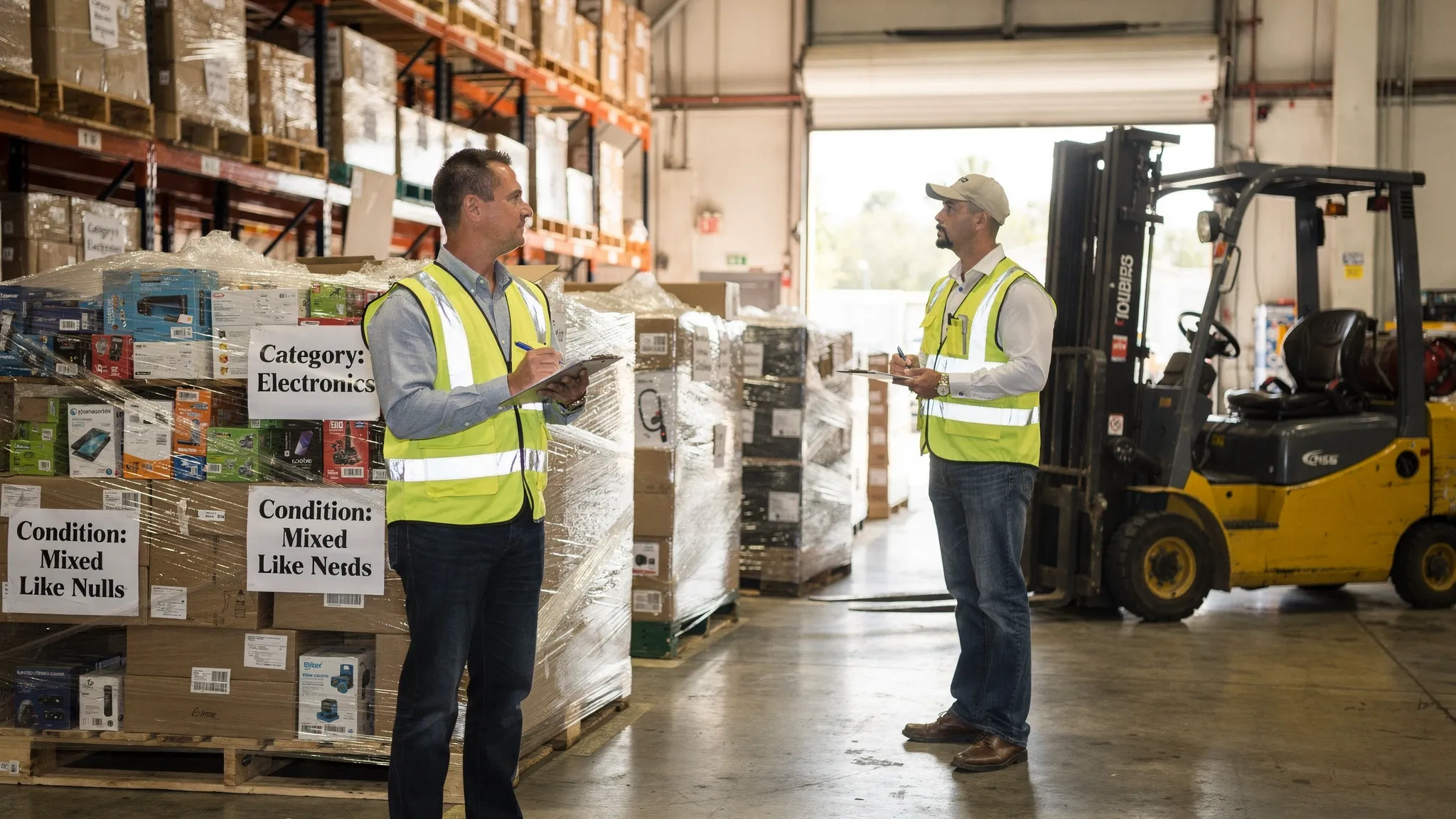
Minute-by-minute: how to run the walkthrough
Minute 0 to 2: Confirm the warehouse is set up for liquidation (not chaos)
Start outside.
Look for practical indicators that the site regularly handles freight and pallet traffic:
- Truck access and turning space
- Clear receiving or dock area
- Business name on a sign, door, or paperwork station
A liquidation warehouse can be small and still legitimate, but it should feel like a place that repeatedly receives and moves inventory. If the “warehouse” is really a shared storage unit maze with no staging, no dock plan, and no staff flow, your pickup day will become a time sink.
Minute 2 to 4: Ask one question that exposes experience
In the office or at the check-in point, ask:
“How do you define your condition grades?”
A real operator answers in a consistent way (for example, shelf-pulls vs customer returns vs salvage) and can tell you what that means for missing parts, testing, and expectations.
If you hear only sales language like “high value” or “tons of profit,” with no operational definitions, that’s a warning sign.
If you want a deeper “questions to ask” script (beyond the 10-minute version), keep this bookmarked: Pallets Store Guide: What to Ask Before You Buy.
Minute 4 to 6: Inspect staging, not just one “pretty” pallet
Walk to the staging area and look at the average pallet, not the one they chose for you.
You’re checking whether their operation protects your resale outcomes:
- Pallets are wrapped and stable (less transit damage, fewer missing items)
- Lots are separated by type (less “mystery mixing”)
- Labels or lot IDs exist (basic traceability)
Also look for “honesty cues.” Most liquidation has some damage, open boxes, and missing parts. A warehouse that admits that, and still runs clean staging, is usually safer than a warehouse that claims everything is perfect.
Minute 6 to 8: Verify paperwork and how they talk about manifests
Ask to see:
- A sample manifest (even a redacted one)
- A lot identifier that matches what you’re looking at
- Their terms in plain language (as-is, what claims exist, if any)
Manifests are not magic, but they are a seriousness signal. If you’re buying retailer return pallets or Amazon return pallets, manifests help you estimate processing time, likely defect rates, and your best sales channels.
If you’re newer to Amazon-origin inventory, these explainers can help you understand what “returns” actually means:
Minute 8 to 10: Confirm pickup and shipping aren’t an afterthought
Even if you’re buying locally today, you may scale later, and you do not want to rebuild your supply chain from scratch.
Ask these fast operational questions:
- “Do you load with a forklift, and is it included?”
- “Do I need an appointment for pickup?”
- “If you ship, do you provide tracking and a BOL process?”
Good suppliers have boring, repeatable answers. Bad suppliers make the logistics your problem.
If you’re deciding between local pickup and freight delivery, this comparison is worth reading: Liquidations Near Me: Pickup vs Freight Delivered Pallets.
A simple decision rule: Pass, Maybe, or No
At the end of the 10 minutes, classify the warehouse so you don’t overthink it.
Pass if:
- They clearly explain source and condition
- They can show staged pallets that match their description
- They provide manifests (or explain when they can’t) and have basic terms
- Loading and pickup rules are clear
Maybe if:
- They seem legitimate but inventory is inconsistent
- Manifests exist but accuracy is unclear
- The operation is real but disorganized
No if:
- They cannot show inventory that matches what they sell
- They refuse paperwork entirely, or pricing/terms change on the spot
- The address or operation does not behave like a warehouse
If your main concern is fraud, this scam-focused guide goes deeper than a walkthrough can: Liquidation Pallets Near Me: How to Avoid Scams.
The “10-minute kit” to bring (or request on video)
You don’t need equipment, just a few basics that help you make quick judgments.
- A flashlight (to check dark wrap corners and label details)
- Work gloves (to safely handle boxes)
- A marker and notebook (write down lot IDs and questions)
- Your phone camera (document wrap, labels, and condition examples)
- A simple max-bid rule (so you don’t negotiate against yourself)
If you’re vetting remotely, ask for a live video walkthrough showing (1) the building exterior and signage, (2) staging rows, (3) one pallet unwrapped at the corner, and (4) paperwork that matches the lot ID.
Don’t skip the “people” factor (especially if you have a team)
A warehouse can be legitimate and still be a bad match if communication is weak. In liquidation, small misunderstandings become expensive fast (claims, missing pallets, condition disputes, pickup timing).
If you have staff who negotiate buys, handle receiving, or run customer service for your resale operation, consider practicing those conversations with AI roleplay training from Scenario IQ so your team can handle objections and clarify terms before money changes hands.
When “near me” isn’t the best choice
Local can be great, but local can also cap your scale. If you want consistent volume, clearer paperwork, and shipping options that let you buy beyond your metro area, many resellers move from “near me” sourcing to nationwide suppliers.
A balanced approach in 2026 looks like this:
- Use local warehouses for quick turns, learning, and occasional opportunistic buys
- Use nationwide pallet and truckload suppliers for repeatable inventory and growth
If you’re thinking about truckloads, this guide is a strong safety framework: American Liquidations: How to Buy Truckloads Safely.
Frequently Asked Questions
How do I find wholesale pallets near me without wasting time? Start with warehouses that list a real industrial address, show consistent pallet photos (not stock images), and can explain condition grades and manifests. Then run the 10-minute walkthrough before you negotiate.
Should I only buy from a warehouse if they provide a manifest? Not always, but a manifest (even partial) is a strong professionalism signal. If there’s no manifest, you need stronger proof on inventory visibility, lot consistency, and pricing that reflects higher uncertainty.
What is the biggest red flag when vetting a liquidation warehouse? When the warehouse cannot show inventory that matches what they’re selling, or terms change once you arrive. In liquidation, inconsistency is usually a preview of losses.
Is it better to pick up pallets locally or have them shipped? Pickup can reduce freight cost and let you inspect, but shipping can unlock better selection and scale. Use landed cost math and your processing capacity to decide.
How can I avoid buying the wrong category of pallets? Match categories to your sales channel and testing ability. For example, electronics can be profitable but require a workflow. This guide helps: Liquidation Electronics: What to Buy and What to Avoid.
Buy with confidence, locally or nationwide
If your 10-minute walkthrough leaves you with doubts, it’s okay to walk away. The best resellers protect cash first and scale second.
When you’re ready for a supplier built for volume, American Bulk Pallets offers wholesale liquidation pallets and direct truckload sourcing from major retailers, with manifests provided, competitive pricing, and nationwide and international shipping.
Explore options and next steps here: American Bulk Pallets. For more buying frameworks, start with Wholesale Pallet Sales Near Me: How to Compare Suppliers.