
Tool pallets can be some of the best inventory for cash flow, because even imperfect tools often sell fast if you price them the right way. The problem is that “tools” covers everything from brand new hand tools to missing-battery power tools to parts-only lots, and pricing them like normal retail products is how resellers end up with slow movers.
This guide is built specifically for pallet tool sales: how to price tool lots for quick turn, protect your margin, and avoid spending hours “researching comps” for every single item.
Why tool lots are different from other liquidation categories
Tools behave differently than apparel, toys, or general home goods because buyers usually care about:
- Compatibility (battery platform, charger type, blade size, drive size, accessory fit)
- Completeness (tool-only vs kit, missing parts, no case)
- Proof of function (tested, untested, for parts)
- Brand and model (some brands move in any condition, others only sell if new)
In liquidation, you also get common “margin killers” that directly change what your quick-turn price should be:
- Missing batteries, chargers, and accessories
- Cosmetic damage that does not affect function (but affects buyer confidence)
- Unknown history (returns can be fine, but buyers assume risk)
- Time cost to test, clean, photograph, and list
So the goal is not “highest possible price.” It is fast, predictable sell-through that keeps your cash moving.
Start with the end in mind: pick your fastest sales lane
Before you price anything, decide where the lot is going. Your pricing should match the lane’s buyer expectations and your workload.
Fastest local lanes (usually best for quick turn)
Local lanes are often the quickest way to move mixed-condition tool lots because buyers accept “as-is” more readily.
- Facebook Marketplace / OfferUp style listings
- Flea markets and swap meets
- Contractor and handyman buyer networks
Local lanes typically favor bundle pricing (one price, pickup today) over perfectly itemized listings.
Online lanes (good money, slower and more work)
Online channels can pay more for tested items, but they add shipping, returns, fees, and time.
- eBay (great for parts, chargers, niche accessories)
- Your own website (best if you already have traffic)
- Amazon (works for certain compliant SKUs, but tools can bring higher return risk)
If you sell online, make sure you understand compliance and paperwork basics. The checklist approach in Pallets Store Guide: What to Ask Before You Buy maps well to tools because condition, manifests, and restrictions matter.
The quick-turn pricing mindset: you are selling risk and time, not just tools
A retail buyer pays for convenience and certainty. A liquidation buyer discounts for:
- Unknown condition
- Missing pieces
- No warranty
- “I have to test it” effort
To move tools fast, you should price the lot so the buyer feels like they are winning immediately, even if they have to do a little work.
That means your system needs two levers:
- A condition factor (what’s the risk?)
- A speed discount (how fast do you want it gone?)
Build a simple, repeatable tool grading system (that drives price)
You do not need a complicated grading rubric. You need one your team can apply in seconds.
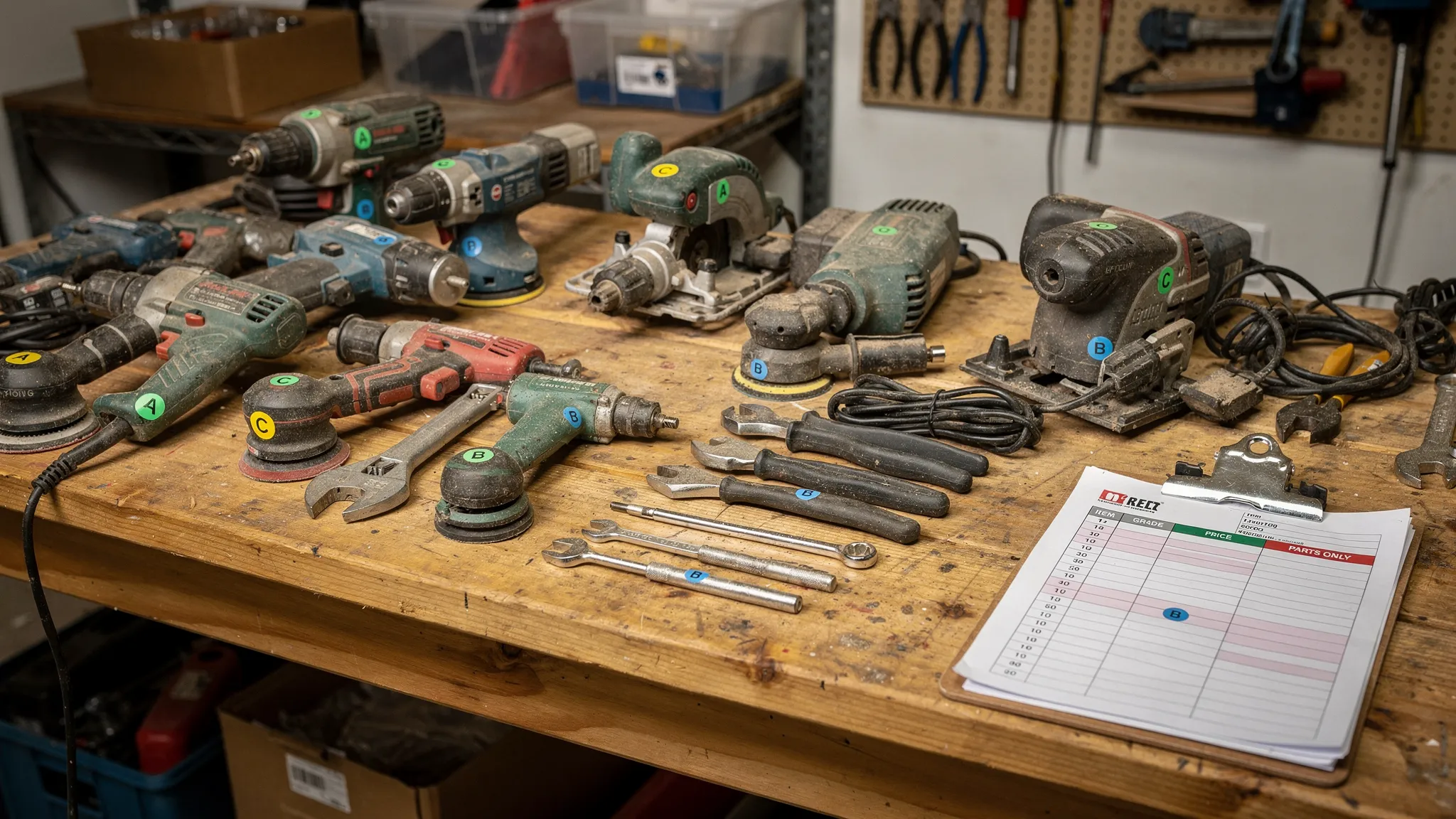
Here is a practical grading system that works well for tool lots from retailer returns and liquidation pallets.
| Grade (for pricing) | What it means in plain English | Typical buyer expectation | Your best lane |
|---|---|---|---|
| A: Tested working, complete | Powers on, runs, includes key accessories (or clearly listed) | “Ready to use” | Online listings, premium local bundles |
| B: Powers on or likely working, incomplete | Works but missing battery/charger, or light cosmetic issues | “I’ll source the missing pieces” | Local sales, bundle kits, some online |
| C: Untested or uncertain | Not tested, or no way to test quickly | “I’m taking a gamble” | Bulk lots, flea market, local “as-is” |
| D: Parts/repair | Known broken, damaged, or incomplete beyond easy fix | “Parts value only” | eBay parts lots, scrap/parts buyers |
The key is consistency. Buyers will come back if your “tested” really means tested and your “as-is” is priced like as-is.
A fast pricing formula for pallet tool sales
For quick turn, you need a price you can calculate without overthinking.
Use this framework:
Quick-Turn Price (QTP) = Reference Value × Condition Factor × Speed Factor
Step 1: Find a reference value in minutes, not hours
Pick one:
- Local reference value: what similar items actually sell for in your area
- Online sold comps: completed sales, not asking prices
- Replacement value: what it costs to buy the missing piece (battery, charger, case)
You do not need precision for every SKU when selling lots. You need a reliable “good enough” reference.
Step 2: Apply a condition factor (your risk discount)
Here is a simple starting point that many tool resellers use as a rule of thumb.
| Condition | Condition factor | Notes |
|---|---|---|
| Tested working, clean | 0.60 to 0.80 | Higher end if complete kit and in-demand brand |
| Working but missing key accessory | 0.40 to 0.65 | Subtract for missing battery/charger because buyer must invest more |
| Untested | 0.20 to 0.45 | Price so the buyer can lose on a few items and still win |
| Parts/repair | 0.05 to 0.25 | Driven by parts demand, brand, and whether it is a common failure |
These are not “magic numbers.” They are a way to force discipline so you do not price untested inventory like tested inventory.
Step 3: Apply a speed factor (how fast you want it gone)
Speed is a business decision.
- Need it gone this weekend? Use 0.75 to 0.90
- Comfortable holding 2 to 4 weeks? Use 0.90 to 1.00
- Willing to hold longer for higher dollars? Use 1.00+, but expect slower turn and more buyer questions
Quick turn usually means you should be comfortable taking a smaller win on each deal to keep the cash cycle moving.
How to price tool lots (not individual tools) for fast sale
Tool pallets are often messy: mixed brands, mixed volt platforms, missing accessories. Lot pricing solves that.
Lot type 1: “Ready-to-work” bundles (highest quick-turn price)
These are bundles you assemble from your best items.
Examples:
- Drill + impact + 2 batteries + charger (same platform)
- Saw + blades + case
- Shop tool + attachments
Pricing rule: Aim for a buyer who wants to use it today. Your price should be clearly cheaper than buying used items individually, but high enough that your testing time is paid.
Lot type 2: “Platform” lots (best balance of speed and margin)
Battery platform compatibility is everything. A mixed pile sells slowly, but a platform lot moves.
Examples:
- 18V tools only (tool-only, no batteries)
- Chargers and batteries lot (tested, labeled)
Pricing rule: Price around the ecosystem. If batteries are missing, your discount must reflect what batteries cost and how hard they are to source.
Lot type 3: “As-is mixed tool lot” (fastest liquidation)
This is what you use to clear untested and incomplete items quickly.
Pricing rule: price so a local buyer can:
- Resell a few good items and break even
- Scrap or part out the rest without feeling burned
If you cannot explain the value story to the buyer in one sentence, the lot will sit.
What to do about missing batteries and chargers (the #1 pricing issue)
Missing power accessories are where resellers misprice tools.
A practical approach:
- Separate your inventory into three bins: tools-only, chargers, batteries.
- Test what you can quickly (even a basic “charges and holds for a short run” check beats untested).
- Price kits higher than parts: a complete kit sells faster than its pieces.
For tools-only lots, be explicit in the listing. “Tool only, no battery/charger” reduces messages, no-shows, and returns.
Quick-turn pricing examples (hypothetical, but realistic)
These examples show how the formula works. The numbers are illustrative, you should plug in your local comps and your real costs.
Example A: Tested working combo kit (fast local sale)
- Reference value (local used selling price for similar kit): $180
- Condition factor (tested working, complete): 0.75
- Speed factor (sell within 7 days): 0.85
QTP = 180 × 0.75 × 0.85 = $114.75, round to $115
This is the type of price that drives a “cash today” buyer.
Example B: Tool-only impact driver (missing battery/charger)
- Reference value (same tool in working kit context): $90
- Condition factor (working but missing key accessory): 0.55
- Speed factor (2-week target): 0.95
QTP = 90 × 0.55 × 0.95 = $47.03, round to $45 to $50
Example C: Mixed untested lot of 12 items
Instead of pricing each item, set a buyer outcome goal:
- Buyer should be able to recover their money by selling 3 to 5 items
- The rest is upside
If your quick scan suggests the lot contains at least $600 of “if working” value, then a common quick-turn move is:
- Untested condition factor range: 0.25 to 0.35
- Speed factor for weekend sale: 0.80 to 0.90
$600 × 0.30 × 0.85 = $153
List at $175 and be ready to take $140 to $160 for immediate pickup.
How to use “price ladders” to move everything, not just the good stuff
A lot of resellers sell the best tools first, then get stuck with a death pile of leftovers.
Instead, build a price ladder that matches effort and certainty:
- Tier 1 (highest price): tested, complete kits
- Tier 2: tested tool-only items priced to move
- Tier 3: untested lots priced for risk-takers
- Tier 4 (fastest exit): parts/repair lots and scrap
This keeps your operation healthy because you are always converting inventory back into cash.
Listing copy that helps tool lots sell faster (without lowering price)
Better copy increases speed without automatically discounting.
For local sales, include:
- A clear statement of testing level (tested, untested, parts)
- What is included (battery, charger, case, blades, bits)
- A simple reason for the price (bundle deal, quick sale, pickup today)
Example phrasing:
“Tool-only lot, no batteries/chargers. Untested, sold as-is. Priced for quick pickup today.”
That one sentence eliminates a lot of back-and-forth.
A quick workflow for pricing at scale (pallets, not one-offs)
The fastest resellers treat pricing like an assembly line.
Triage
Open boxes, separate by category, and pull out obvious trash or unsafe items.
Test the winners
Test only what moves the needle, typically high-demand tools, batteries/chargers, and complete kits. This is where you earn “tested” pricing.
If your tool pallets include small appliances mixed in (it happens with general merchandise returns), basic diagnostic reading can help you decide whether to test, part out, or bulk sell. A practical resource for quick troubleshooting ideas is the PHX Appliance Fix Blog, especially if you regularly handle kitchen and laundry items alongside tools.
Bundle
Build kits and platform lots first, then push leftovers into untested or parts lots.
Price with your formula
Reference value, condition factor, speed factor, done.
Protect your margin: don’t ignore the hidden costs of tool lots
Quick turn still has to be profitable. If you sell too low, you are just doing labor for free.
At a minimum, account for:
- Your inbound freight and handling
- Consumables (labels, tape, batteries for testing, cleaning supplies)
- Marketplace fees and payment processing (if online)
- Returns and warranty expectations (especially online)
If you want a clean way to think about the full picture, the cost structure breakdown in Liquidation Business Basics: Costs, Permits, and Profit Math helps you assign real numbers to labor and overhead so your “quick sale” does not become a loss.
Where resellers win on tool pallets: sourcing consistency and manifests
Pricing is easier when your incoming inventory is consistent and documented.
- Manifests help you estimate what you can build into kits and what will become bulk lots
- Reliable grading reduces surprises that destroy your pricing plan
- Freight planning matters because tools are heavy, and landed cost can change your “must sell at” number
If you are scaling from pallets into larger buys, read American Liquidations: How to Buy Truckloads Safely before committing to volume.
For tool-heavy inventory specifically, Home Depot Returns Pallets: Tools, Hardware, and ROI Tips pairs well with this pricing guide because it covers the common tool pallet gotchas that affect sell-through.
Buying better makes pricing easier (and faster)
If your pallets are overloaded with low-demand brands, missing accessories, or heavily damaged items, no pricing trick saves you.
To improve your starting position:
- Compare suppliers using a consistent scorecard (manifests, grading clarity, freight terms)
- Avoid deals with vague descriptions and no condition guidance
The framework in Wholesale Pallet Sales Near Me: How to Compare Suppliers is a solid way to pressure-test a “great deal” before you buy it.
Sourcing pallets and truckloads for tool resale
If you are building a repeatable tool resale operation, your best advantage is a steady supplier that can support volume, provide manifests when available, and ship nationwide.
American Bulk Pallets supplies wholesale liquidation pallets and direct truckload inventory for resellers, with shipping options across the U.S. and international destinations. You can explore available inventory and sourcing options directly at American Bulk Pallets.
The fastest operations are not the ones that guess the perfect price, they are the ones that:
- Grade consistently
- Bundle intelligently
- Price for speed based on risk
- Reorder from dependable supply