Retail returns are one of the biggest, most misunderstood inventory streams in U.S. resale. Done right, pallet returns can turn into steady cash flow for online sellers, flea market vendors, bin stores, and small wholesalers. Done wrong, they turn into chargebacks, hazmat headaches, angry customers, and cash tied up in slow-moving junk.
This guide breaks down how to profit from retail returns safely, with a focus on risk control, clean processes, and numbers that protect your margin.
What “pallet returns” actually are (and what they are not)
In liquidation, “returns” is usually a source label, not a condition guarantee.
A pallet of returns can include a mix of:
- New items with damaged packaging
- Open-box items missing accessories
- Customer returns that work perfectly
- Customer returns that are broken, used, or incomplete
- Items that should never be resold on certain platforms (recalls, restricted products, hazmat)
That’s why the best buyers treat pallet returns as a processing business, not a lottery ticket.
If you want a deeper explanation of what “customer return” means in practice (especially for Amazon-origin inventory), read: Amazon Pallets Returns: What “Customer Return” Really Means.
Why retailers liquidate returns (and why that helps resellers)
Retailers are optimized to sell new product at scale, not to test, rebox, and list one-off returns. Returns create labor, storage, and reputation risk, so many retailers move them out through liquidation channels.
Returns are also a large slice of total retail volume. The National Retail Federation (NRF) estimates U.S. retail returns were $743 billion in 2023, with total returns at 14.5% of sales (and much higher in ecommerce). Source: NRF returns data.
For resellers, that volume matters because it creates consistent supply, but only if you buy with rules.
The profit model: how money is actually made on retail return pallets
You do not make money because the manifest shows a big MSRP number. You make money when your recovered sales beat your all-in costs, fast.
Here are the key drivers to focus on:
| Driver | What it means | Why it matters |
|---|---|---|
| Recovery rate | Percent of your buy cost you expect to resell (after breakage, missing parts, discounts) | The fastest way to overpay is to overestimate recovery |
| Sell-through speed | How quickly you convert inventory to cash | Slow inventory kills cash flow and forces discounting |
| Labor per unit | Minutes to test, clean, price, and list each item | Returns are labor-heavy, labor is a real cost |
| Disposal and shrink | Trash, hazmat handling, broken items, missing parts | These are predictable losses, budget them |
| Channel fit | Matching categories to where you sell (Amazon, eBay, local, bins) | Wrong channel means lower price and higher returns |
A simple safe-buy equation many resellers use is:
Max Buy Price = (Expected Resale Revenue × Conservative Recovery %) − (Freight + Labor + Fees + Disposal) − Target Profit
You can keep it simple at first, but you need a rule that prevents emotional buying.
Buy pallet returns safely: supplier checks that prevent expensive mistakes
Safety starts before you ever touch a pallet.
1) Choose transparent lots (and insist on basic documentation)
At minimum, look for:
- Clear source description (which retailer channel, what type of returns)
- Lot type clarity (manifested vs unmanifested)
- Condition notes (even if broad)
- Invoice or bill of sale
- Shipping terms and delivery expectations
A supplier should be comfortable answering operational questions. If they get defensive, that is a signal.
For a ready-to-use question list, see: Pallets Store Guide: What to Ask Before You Buy.
2) Watch for common fraud patterns
Return pallets attract scammers because new buyers focus on “retail value” and rush payments.
If you are buying locally, or comparing “warehouse pickup” deals, use this scam-proof framework: Liquidation Pallets Near Me: How to Avoid Scams.
3) Use a red-flag, green-flag checklist
| Green flags | Red flags |
|---|---|
| Real business identity, verifiable location, consistent paperwork | Only messaging apps, no traceable business info |
| Clear lot description, sample photos, and reasonable expectations | “90% brand new” promises and vague answers |
| Freight terms explained, delivery appointment guidance | Pressure to pay fast, confusing shipping charges |
| Repeatable inventory streams and support for resellers | “One-time deal” stories and shifting explanations |
If you want to quickly vet a location in person, use: Wholesale Pallets Near Me: Vetting a Warehouse in 10 Minutes.
“Safely” also means operational and compliance safety
Most buyers think “safe” just means not getting scammed. In returns, safe also means protecting your business from preventable compliance and liability issues.
Restricted items, recalls, and resale platform rules
Retail return pallets can contain products that are:
- Recalled
- Missing required safety labels
- Not legal to ship by air (lithium batteries, aerosols)
- Restricted or gated on marketplaces
- Counterfeit or brand-sensitive (especially accessories)
At minimum, build these habits:
- Check the CPSC recall database before listing higher-risk categories (baby, kitchen appliances, power tools).
- Treat cosmetics, ingestibles, and baby items as higher-risk categories unless you have strong controls.
- Create a “restricted bin” on day one, anything questionable goes there until verified.
If you sell on Amazon, do not assume you can list everything. “Ungated” today can become restricted tomorrow, and some categories require invoices and compliance documentation.
Hazmat and lithium battery reality
Returns often include damaged packaging or loose batteries. If you are not set up to identify and separate hazmat, you can create shipping violations or safety hazards.
A practical approach:
- Assume any mixed general merchandise pallet may include hazmat
- Separate aerosols, chemicals, and swollen or damaged batteries immediately
- Do not ship questionable batteries until you confirm proper packaging and carrier rules
If you buy electronics-heavy returns, be especially careful. (This is also where margin can disappear fastest.) See: Liquidation Electronics: What to Buy and What to Avoid.
A safe receiving workflow for pallet returns (this is where pros win)
The first 24 hours after delivery determines whether returns become profit or chaos.
Step 1: Document before you move product
When the freight arrives:
- Photograph the pallet(s) on the truck and on the dock
- Photograph any visible damage, broken wrap, crushed boxes
- Count pallets and compare to paperwork
- Note exceptions on delivery documents when appropriate
This protects you in disputes and improves your own buying data.
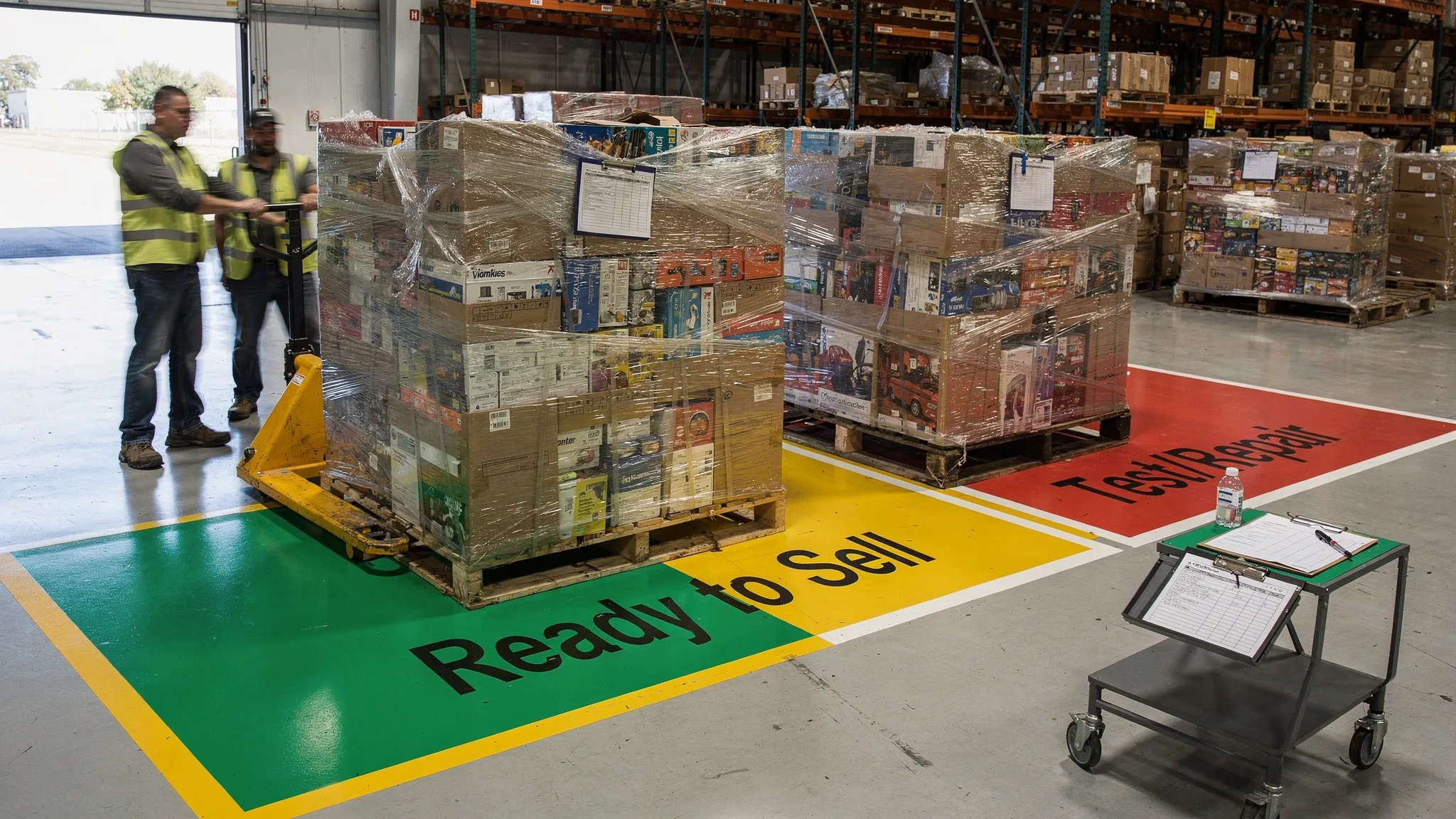
Step 2: Triage into three lanes
A simple lane system keeps labor predictable:
| Lane | Definition | Goal |
|---|---|---|
| Ready-to-sell | New, sealed, or clearly complete and functional | List fast, convert to cash |
| Needs work | Missing accessories, open-box, light repair, testing required | Standardize tests, limit time per unit |
| Parts/disposal | Broken, unsafe, missing critical pieces, low-value | Stop the bleeding, recover parts if worth it |
A key discipline: cap your labor on “needs work” items. Without a cap, you can spend $25 of labor to recover $15 of value.
Step 3: Grade honestly and price for your channel
Returns profit is not just buying right, it is pricing right.
- Flea market and local sales reward speed and bundles
- eBay rewards accurate condition notes and completeness
- Amazon rewards standardization and compliance, but punishes mistakes
If you need a broader framework on grades and real-world margin math, this guide is a strong companion: Liquidation Pallets: Grades, Loads, and Real Profit Examples.
A conservative profit example (so you do not overpay)
Here is a simple example using conservative assumptions. Numbers will vary by category, freight distance, and how skilled your operation is.
| Item | Example value |
|---|---|
| Expected resale revenue (after discounts) | $3,600 |
| Conservative recovery haircut (breakage, missing parts) | 20% (minus $720) |
| Freight delivered | $450 |
| Labor (sorting, testing, listing) | $600 |
| Marketplace fees and payment processing | $450 |
| Disposal, supplies, incidentals | $150 |
| Target profit | $600 |
| Max buy price | $630 |
In this example, paying $1,200 because the “MSRP is $8,000” would likely be a loss. Paying $600 to $700 could be workable if your assumptions are real.
The point is not the exact number, it is the discipline: price the pallet from the exit backwards.
When pallet returns are the right move, and when to switch to truckloads
Pallet returns are often the smartest way to build your system before scaling.
Pallets tend to win when you:
- Are still learning recovery rates by category
- Have limited space or part-time labor
- Need faster feedback loops on what sells
- Want to test a new supplier relationship with lower risk
Truckloads can improve unit economics, but they magnify every weakness: storage, labor, disposal, cash tied up.
If you are considering scaling, read: Direct Truckload Liquidations Explained and keep this checklist handy: Truckload Liquidation Checklist: From Quote to Delivery.
International shipping and legal considerations (for buyers outside the U.S.)
If you are sourcing U.S. pallet returns for export, factor in more than freight. You may need clarity on:
- Title transfer and risk of loss
- Inspection windows and dispute process
- Local import rules for restricted categories (batteries, cosmetics, electronics)
- Documentation expectations from customs or your sales channel
For legal guidance related to shipping, trade, and cross-border business, it can be worth speaking with counsel, for example a firm like Henlin Gibson Henlin if you operate in or ship into the Caribbean.
Where to source pallet returns with fewer surprises
Your safest path to profit is buying from a supplier that supports resellers with clear descriptions, manifests when available, and logistics help.
American Bulk Pallets supplies wholesale liquidation pallets and direct truckload liquidations, with shipping options for U.S. buyers (and international shipping available on request). To explore options and talk through what fits your sales channel, start here: American Bulk Pallets wholesale liquidation pallets.
If you are deciding between pallets and truckloads for your operation, this comparison guide also helps you choose the right scale without blowing up cash flow: Amazon Bulk Liquidation: Pallets vs Truckloads for Resellers.