
Buying liquidation wholesale is one of the fastest ways to stock a resale business, and one of the easiest ways to lose money if you compare the wrong things.
Most buyers shop by “price per pallet” or “total MSRP,” then get surprised by freight, missing parts, restricted items, slow sell-through, or a supplier that disappears after payment. The fix is simple: compare suppliers and lots using the same inputs every time, then only scale what proves repeatable.
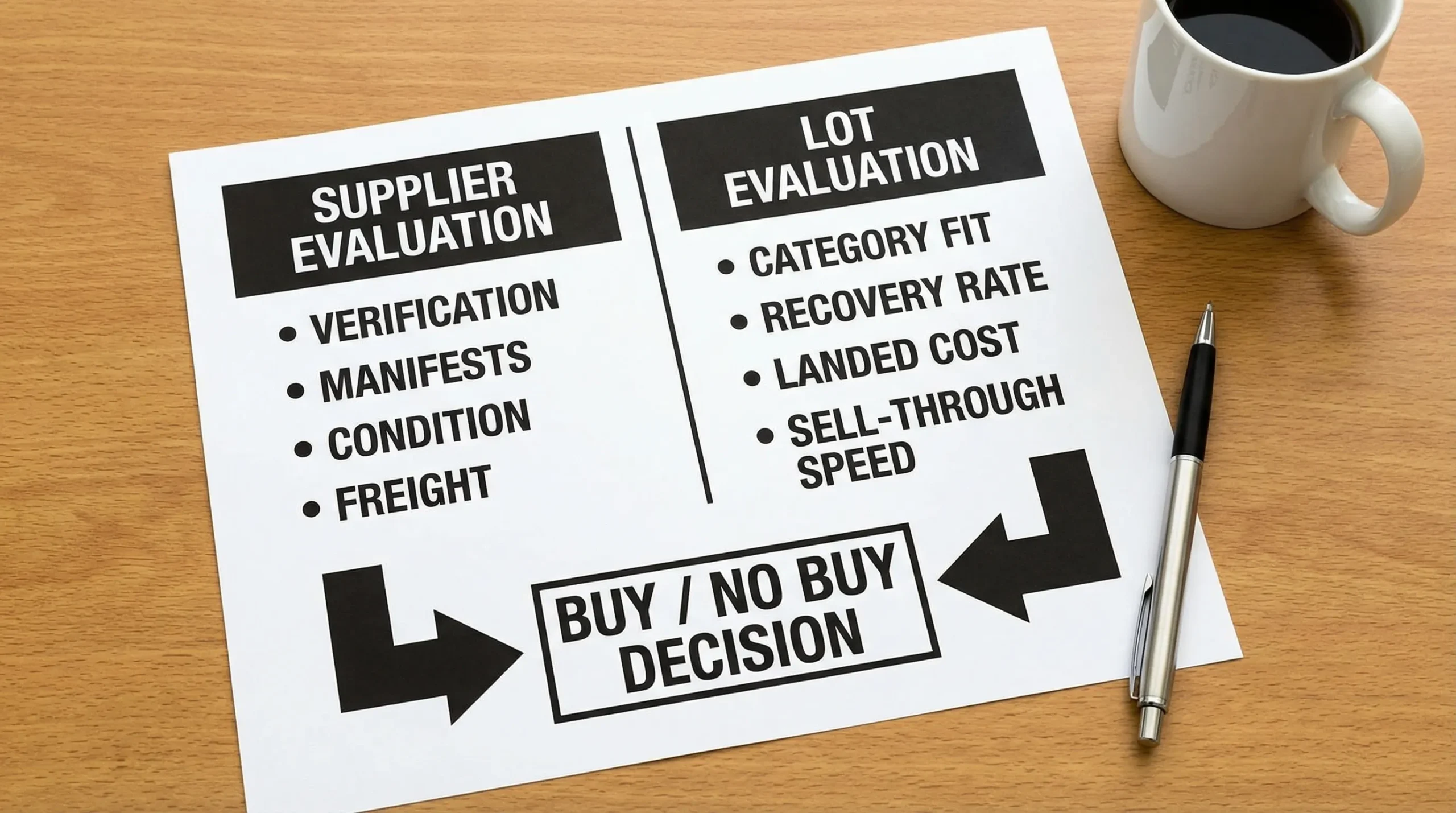
This guide gives you a practical framework to evaluate liquidation wholesale suppliers and the actual pallets or truckloads you are buying.
What “liquidation wholesale” really includes (and why it matters when comparing)
In liquidation wholesale, you are usually buying inventory that a retailer or brand no longer wants to process through normal retail channels. That inventory can come from different streams, and the stream changes your risk, labor, and margins.
Common liquidation wholesale lot types include:
- Overstock and closeouts: Often cleaner, more predictable, typically less labor.
- Shelf pulls: Pulled from stores (season changes, planogram resets), condition varies.
- Customer returns: Source is clear, condition is not (opened, missing parts, used, damaged).
- Salvage: Highest risk, often for parts or local “as-is” sales.
Lots also come in different purchase sizes:
- Single pallets: Best for testing a new category or supplier.
- Partials (multi-pallet): Better pricing than singles, still manageable.
- Truckloads: Best pricing per unit when you have space, labor, and proven recovery rates.
If you are deciding between pallet and truckload purchasing, it helps to read both Liquidation by the Pallet: When It Beats Buying a Truckload and Direct Truckload Liquidations Explained to match your buying size to your capacity.
Step 1: Compare liquidation wholesale suppliers (not just listings)
A lot can look great on paper and still be a bad buy if the supplier is inconsistent, vague, or hard to verify. Before you compare “deals,” compare the business behind the deals.
Supplier types (and what to expect from each)
- Direct sources (or direct programs): Closer to the retailer stream, often more consistent when available.
- National liquidation wholesalers: Usually aggregate supply, can offer variety and logistics support.
- Local warehouses: Convenient for pickup, quality can swing widely.
- Brokers: Can help find inventory fast, but add layers and sometimes reduce transparency.
- Auctions: Can be good for experienced buyers with strict math, but often less predictable.
You are not choosing a “type” that is always best. You are choosing the most repeatable option for your model.
A supplier scorecard you can use before you buy
Use a simple scoring system so you do not get swayed by retail value claims or “hot” categories.
| Supplier factor | What “good” looks like | Why it matters |
|---|---|---|
| Business verification | Real address, business registration, reachable support | Reduces fraud and bait-and-switch risk |
| Inventory source clarity | Clear retailer/category stream (returns, overstock, shelf pulls) | Predicts condition and labor |
| Manifest discipline | Manifest provided when applicable, fields are usable | Makes lots comparable and reduces surprises |
| Condition disclosure | Plain-language grading with examples and limits | Helps you model recovery rate |
| Photos and lot description | Lot-specific photos and realistic descriptions | Prevents “stock photo” misrepresentation |
| Freight support | Clear shipping terms, accessorials, tracking | Freight errors can erase margin |
| Claims and exceptions policy | Documented process for freight damage or major mismatch | Reduces downside on big buys |
| Consistency over time | Similar lots available regularly | Lets you scale with fewer surprises |
If you want a question-by-question script for vetting sellers, keep this guide open while you review Pallets Store Guide: What to Ask Before You Buy.
Red flags to treat as “no-buy”
A strong rule in liquidation wholesale is: if you cannot verify the supplier and the lot, do not “try it once.”
Common red flags include:
- Only accepting irreversible payment methods for first-time buyers
- Refusing to provide a bill of sale or basic paperwork
- Listings that focus on MSRP but avoid condition and testing expectations
- “Too good to be true” claims (perfect new items, huge brands, tiny price) without proof
- No clear pickup or delivery process, or constantly changing addresses
For a deeper scam checklist tailored to pallet buyers, see Liquidation Pallets Near Me: How to Avoid Scams. You can also reference consumer guidance from the FTC when evaluating online sellers and payment risk.
Step 2: Compare lots (what you are actually buying)
Once the supplier passes your baseline, the next job is comparing lots in a way that produces the same answer whether you are looking at tools, general merchandise, or electronics.
Manifested vs unmanifested: how to compare fairly
A manifest is not a guarantee, but it is still one of the best tools you have for normalizing risk.
A useful manifest typically helps you answer:
- How many units are in the lot (and whether unit counts match reality)
- What categories dominate the load
- Whether the load is top-heavy (a few high-ticket items) or volume-based
- Which items likely require testing, missing parts handling, or hazmat screening
If you are buying return-heavy inventory, re-check how you interpret the words “customer return.” This matters because it describes the source, not the condition. Amazon Pallets Returns: What “Customer Return” Really Means breaks this down with a practical workflow.
Build a “lot worksheet” so every deal is apples-to-apples
Instead of asking “Is this cheap?”, ask “What is my expected recovery after all costs and time?”
Here is a worksheet structure you can copy into a spreadsheet.
| Lot variable | Your input | Notes |
|---|---|---|
| Total landed cost (inventory + freight + fees) | Use delivered-to-door numbers | |
| Units (from manifest or estimate) | Flag lots with unclear counts | |
| Estimated sellable rate (%) | Varies by condition stream | |
| Avg selling price (blended) | Use your real comps, not MSRP | |
| Marketplace fees and payment fees | Varies by channel | |
| Labor hours to process | Receiving, sorting, testing, listing | |
| Disposal/unsellable cost | Dump fees, recycling, hazmat | |
| Expected sell-through window | Cash flow matters as much as margin |
When two lots are close in price, sellable rate and labor hours usually decide which lot is actually better.
A simple “max buy price” formula for liquidation wholesale
You do not need perfect data to protect yourself. You need a conservative cap.
One practical approach:
Max buy price = (Expected recoverable revenue) − (All non-inventory costs) − (Required profit buffer)
Where:
- Expected recoverable revenue is what you reasonably expect to collect after discounts (based on your lanes)
- Non-inventory costs include freight, labor, repairs, supplies, marketplace fees, and disposal
- Profit buffer is the minimum profit you need for the risk and time (many resellers treat this as non-negotiable)
If you are not sure how to model recovery rate and landed cost, Liquidation Pallets: Grades, Loads, and Real Profit Examples walks through the exact thinking that keeps buyers from overpaying.
Step 3: Normalize landed cost so supplier comparisons are fair
Two suppliers can list the same category at the same price and still have wildly different outcomes because landed cost is different.
Use the same cost buckets every time:
| Cost bucket | Examples (typical) | Why it gets missed |
|---|---|---|
| Freight | LTL, partial, truckload | Quotes change by lane, season, and access |
| Accessorials | Liftgate, residential, limited access, appointment | Small fees that stack up |
| Receiving | Unloading labor, pallet jack/forklift, dock time | Time is real cost |
| Processing | Sorting, testing, cleaning, rebagging, kitting | Labor multiplies on returns |
| Repairs and missing parts | Chargers, batteries, cords, hardware | Common margin leak in tools and electronics |
| Disposal | Trash, recycling, hazmat handling | Unsellables cost money twice |
| Channel fees | eBay/marketplace fees, payment processing | Easy to underestimate |
If you want a truckload-specific version of this thinking, use Liquidation Truckloads for Sale: What to Check alongside your freight quote.
Step 4: Match lots to your resale lanes (so you are not forced into bad exits)
A lot is only “good” if it matches how you sell. The same pallet can be profitable for a flea market vendor and unworkable for an Amazon seller.
A reliable approach is to plan at least two exit lanes before you buy:
- Lane A (primary): Your best margin lane (Amazon, eBay, Shopify, in-store)
- Lane B (backup): Your fast-cash lane (local bundles, flea market tables, bin store, wholesale to other resellers)
When you compare lots, pay attention to lane friction:
- Electronics and high-value items can require testing, returns handling, and data wipe procedures (labor heavy).
- Some categories have shipping pain (bulky items, fragile items, hazmat risk).
- Marketplace restrictions can limit where you can sell certain brands or item types.
If Amazon-origin inventory is part of your strategy, Amazon Pallets Explained: Conditions, Manifests, and Margins is a solid reference for keeping condition and compliance from surprising you.
Step 5: Use a repeatable buying process (so you can scale liquidation wholesale safely)
Comparing suppliers and lots is not a one-time event. The goal is building a repeatable system that improves as you collect your own data.
A practical workflow that works for pallets and truckloads
Start with these checkpoints:
- Supplier approval: Verify the business, paperwork, and freight process.
- Lot approval: Run your worksheet, confirm category fit, set a max buy price.
- Test order: Buy small enough that a bad outcome does not damage your cash flow.
- Post-load review: Compare what arrived vs what you modeled, then update your assumptions.
Track a few KPIs on every purchase:
- Landed cost per unit (and per sellable unit)
- Recovery rate (revenue collected divided by landed cost)
- Labor hours per $1,000 of revenue
- Sell-through speed (how fast cash comes back)
Those four numbers will make your next supplier comparison much easier than reading any listing.
Where American Bulk Pallets fits when you are comparing suppliers
If your goal is consistent liquidation wholesale sourcing with support, American Bulk Pallets positions itself around the factors that matter in a comparison: wholesale liquidation pallets and direct truckload options, manifests, competitive pricing, and shipping nationwide (with international available).
To keep researching before you buy, these resources help you sharpen your comparison process:
- American Liquidations: How to Buy Truckloads Safely
- Liquidations Near Me: Pickup vs Freight Delivered Pallets
- Liquidation Business Basics: Costs, Permits, and Profit Math
When you are ready to compare real inventory against your worksheet, start at American Bulk Pallets and evaluate lots the same way every time: supplier first, then lot, then landed cost, then lanes.