
When you search “liquidation pallets for sale near me”, you are usually trying to solve one thing: get inventory at a price that still leaves margin after you actually receive it.
But the fastest way to turn a “great deal” into a bad one is underestimating delivery.
In liquidation, freight is not just a shipping line item, it is part of your landed cost (what each sellable unit truly costs once it is in your warehouse). This guide breaks down the real delivery cost components for liquidation pallets and truckloads, and gives you a simple way to estimate them before you buy.
What “near me” really means for liquidation pallets
“Near me” can mean two different buying situations:
- Local pickup: You find a warehouse within driving distance, inspect or buy, and load onto your own vehicle.
- Delivered inventory: You buy from a regional or nationwide supplier and ship to your location by freight (LTL or full truckload).
For many resellers, delivered inventory wins even when it is not local, because the total unit economics can be better when you factor in consistency, manifests, and scalable sourcing.
If you are evaluating local options, this related guide can help you vet a warehouse quickly: Wholesale Pallets Near Me: Vetting a Warehouse in 10 Minutes.
The 3 delivery methods you will see most often
Most liquidation pallet sellers deliver in one of these ways:
Local pickup (your truck, trailer, or box van)
Pickup costs are mostly “your costs”: fuel, time, tolls, labor, rental vehicle, plus risk if you show up and the load is not what you expected.
LTL freight (Less-Than-Truckload)
LTL is when your pallet(s) share trailer space with other shipments. It is common for 1 to roughly 10 pallets, depending on size and weight. LTL pricing is sensitive to:
- Dimensions and total weight
- Freight class (density and handling)
- Whether delivery is commercial or residential
- Accessorials like liftgate, appointment, limited access
FTL or truckload (Full Truckload)
Truckload shipping is typically the best per-unit freight cost when you have volume and the ability to receive it. If you are scaling into volume buys, this guide pairs well with the cost breakdown in this article: Direct Truckload Liquidations Explained.
Delivery cost breakdown: what you are really paying for
Freight quotes can look confusing because the total is usually built from a base charge plus add-ons.
Here are the most common components that affect delivered cost for liquidation pallets.
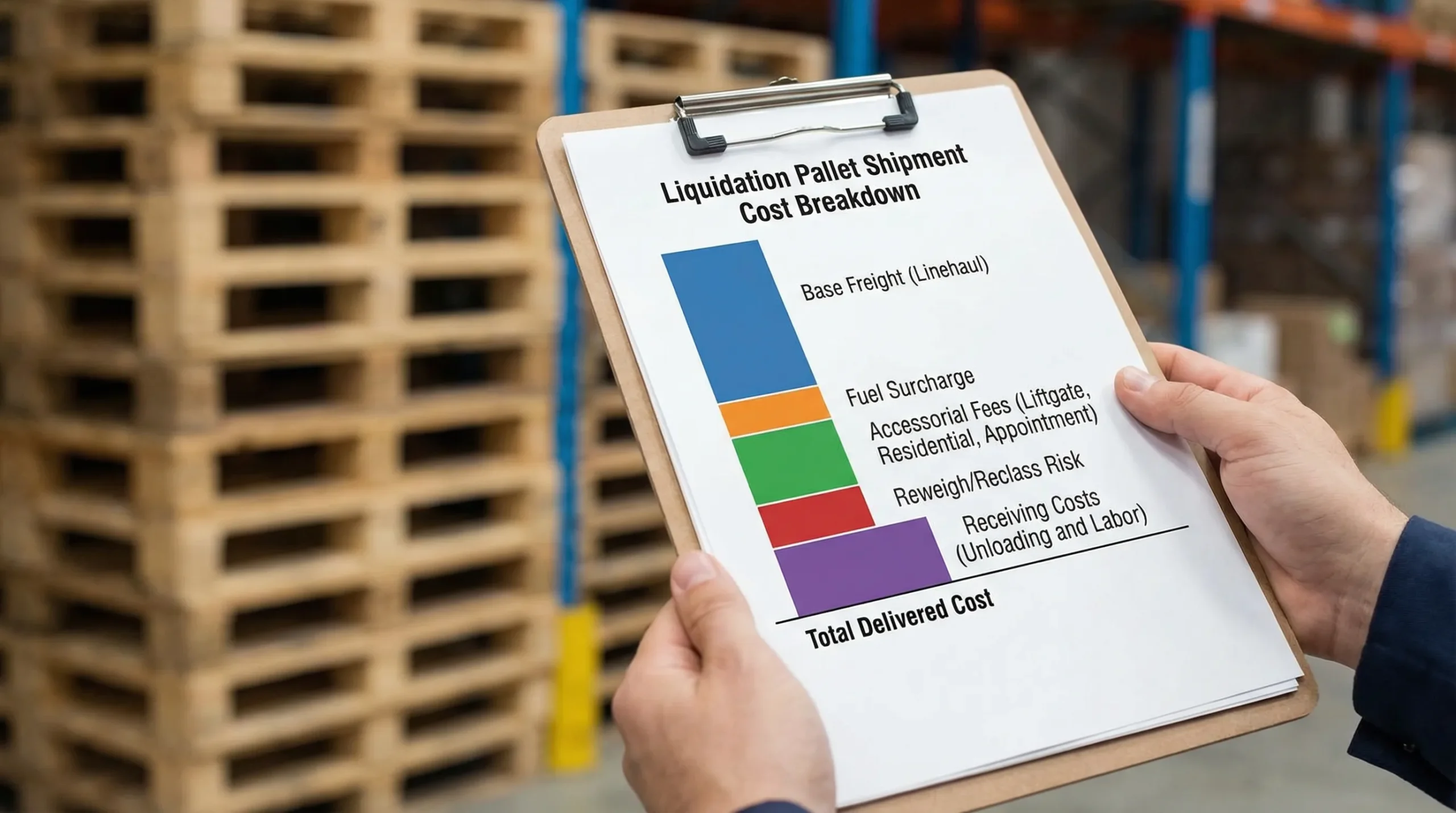
1) Base freight (linehaul)
This is the core transportation charge from origin to destination. It is driven by lane distance and carrier capacity in that region.
2) Fuel surcharge
Fuel is often added as a separate line item and changes frequently.
3) Freight class and density (big deal for LTL)
Many pallet shipments move under NMFC freight class rules, where the density (weight per cubic foot) can push your shipment into a higher class.
If your pallet is larger than expected, lighter than expected (low density), or hard to handle, you can get hit with:
- Reclass: the carrier changes your freight class
- Reweigh: the carrier changes your billed weight
Either one can raise your final invoice versus the original quote.
4) Accessorials (the “gotchas”)
Accessorials are extra fees for special handling or delivery conditions. These are the most common reasons resellers feel blindsided.
| Cost item | What it means | When it shows up | How to reduce it |
|---|---|---|---|
| Liftgate | Truck provides a hydraulic lift to unload | No dock and no forklift available | Deliver to a dock, have a forklift available, or pick up at a terminal where allowed |
| Residential delivery | Delivery to a home address | Garage, house, rural residence | Ship to a commercial address or storage facility that accepts freight |
| Appointment / delivery window | Scheduled delivery time | Limited receiving hours | Provide wide receiving hours and fast scheduling response |
| Limited access | Carrier considers the location “non-standard” | Schools, storage units, fairs, some downtown areas | Confirm address type with the carrier before quoting |
| Inside delivery | Carrier brings freight inside | Requested service | Plan to unload at curb/dock and move it with your team |
| Detention / redelivery | Driver waits too long or must return | You are not ready to receive | Have labor and space ready, confirm contact phone numbers |
5) Pallet size, weight, and stackability
Two pallets that both weigh 900 lbs can price very differently if one is oversized or cannot be stacked.
Before you request a quote, get (and document) these details:
- Number of pallets
- Approximate weight per pallet
- Approximate dimensions per pallet
- Whether pallets can be stacked (often “no” in liquidation)
6) Delivery location realities (dock vs no dock)
LTL carriers are optimized for commercial docks. If you are receiving at a small shop, storage unit, or residential address, accessorials often dominate the quote.
If you want a deeper comparison between pickup and freight delivery, see: Liquidations Near Me: Pickup vs Freight Delivered Pallets.
Your landed-cost worksheet (simple version)
To protect margin, stop thinking “pallet price” and start thinking cost per sellable unit.
Use this formula:
Landed Cost = (Inventory Cost + Freight + Receiving Costs + Disposal/Repair Allowance) ÷ Expected Sellable Units
Receiving costs are real, even if you do the work yourself. Time, unloading, sorting, testing, trash, and returns processing all affect what you actually earn.
A worked example (hypothetical numbers)
This is not a “typical” quote, it is just sample math so you can see the structure.
- Pallet cost: $1,200
- Freight: $350
- Receiving supplies and labor allowance: $150
- Expected sellable units: 80
Landed cost per sellable unit = (1200 + 350 + 150) ÷ 80 = $21.25
If your average sale price is $35 and your selling fees plus overhead average $8 per unit, your margin is not based on the $1,200 pallet price. It is based on the $21.25 unit cost.
Costs “near me” buyers still forget to include
Even when you buy locally, delivery and receiving still create hidden costs.
Unloading equipment
Ask yourself:
- Do you have a dock, forklift, pallet jack, and enough labor?
- Will the driver require you to unload quickly?
- If you are picking up, do you have straps, load bars, and the right vehicle capacity?
Sorting and testing labor
Certain categories (especially electronics) are labor-heavy. If that is your niche, build a labor allowance into every deal. This pairs well with: Liquidation Electronics: What to Buy and What to Avoid.
Trash, recycling, and disposal
Shrink is not only “unsellable items.” It is also packaging waste, broken items, and time.
How to lower delivery cost without lowering inventory quality
Most freight savings come from reducing accessorials and avoiding reclass surprises.
Choose a commercial receiving address when possible
If you can ship to a friend’s business, a small warehouse, or any location with a dock and flexible hours, you can often remove the most expensive add-ons.
Be precise with pallet dimensions and weight
Carriers audit. If your shipment is quoted at one size and shows up bigger or lighter (low density), you risk reweigh and reclass.
Consolidate into more pallets or bigger buys
Small, frequent LTL shipments can cost more per unit than fewer, larger shipments. If your cash flow allows, consolidating purchases can reduce per-unit freight.
Know when to move from pallets to truckloads
Truckload shipping often provides better freight economics per unit, but only if you are operationally ready (space, labor, processing speed).
If you are thinking about scaling, read: Liquidation Truckloads for Sale: What to Check.
Quick decision table: local pickup vs delivered pallets
Use this as a fast reality check when you are comparing “near me” finds to shipped inventory.
| Situation | Usually better option | Why |
|---|---|---|
| You are brand new and want to inspect in person | Local pickup | Lower commitment, easier to walk away |
| You have no dock or forklift and need delivery to a small location | Depends | LTL accessorials can erase the deal |
| You have a dock, flexible hours, and room to process | Delivered pallets | Lower friction, easier scaling |
| You can consistently sell the same categories | Delivered pallets or truckloads | Consistency beats one-off local deals |
| You are scaling into volume and have strong sell-through | Truckloads | Better freight per unit if operations can keep up |
International and cross-border considerations
Some buyers source in the U.S. but operate internationally, or they travel to inspect suppliers and coordinate logistics. If travel or border-crossing paperwork is part of your process, tools like SimpleVisa’s border crossing administration services can reduce admin friction for travel businesses and operators managing multiple destinations.
American Bulk Pallets also offers nationwide and international shipping, so if you are outside the U.S., confirm import requirements, duties, and receiving capabilities before quoting freight.
Frequently Asked Questions
Why is freight so expensive on liquidation pallets? Freight is priced around space, weight, handling, and delivery conditions. Liquidation pallets are often oversized, mixed, and non-stackable, which can push up LTL cost and accessorial fees.
What is the biggest hidden fee when shipping liquidation pallets? Accessorials. Liftgate, residential delivery, limited access, and appointment fees can add up quickly, especially on small LTL shipments.
Is it cheaper to buy liquidation pallets locally? Not always. Local pickup avoids freight invoices, but you still pay in time, fuel, labor, vehicle costs, and risk if the inventory is not as described.
How do I estimate landed cost before buying? Add inventory cost, freight, and a realistic receiving allowance (labor, supplies, disposal), then divide by expected sellable units. If the per-unit number does not work with your selling prices and fees, skip the deal.
When should I switch from LTL pallets to a truckload? When you have consistent sell-through, space to store inventory, and a process to sort and list quickly. Truckloads can improve per-unit freight, but only if your operations can handle the volume.
Ready to price delivery correctly before you buy?
If you want to stop guessing and start buying based on landed cost, work with a supplier that supports resellers with manifests, nationwide shipping, and dedicated customer support.
Browse available inventory and learn more at American Bulk Pallets, then compare pallet and truckload options based on your receiving setup and your target margins.