
If you’re searching for Amazon bulk liquidation, you’re usually trying to answer one practical question: should you start with pallets (smaller, easier to test) or jump to truckloads (bigger volume, lower unit cost potential, higher operational risk)?
Both can be profitable for resellers, but they fit different business stages. The right choice depends less on hype and more on your cash flow, storage, labor, selling channels, and how well you can manage surprises.
What “Amazon bulk liquidation” typically means
In liquidation, “Amazon” lots are usually built from a mix of:
- Customer returns (opened, missing parts, used condition variability)
- Open-box items (often sellable with inspection)
- Overstock or shelf-pulls (generally cleaner, but not guaranteed)
- Salvage or uninspected lots (higher risk, higher labor)
Whether you buy a pallet or a truckload, your outcome depends on condition grade, manifest quality, and your ability to process inventory fast enough to avoid cash getting stuck in unsorted product. If you’re new to the terminology, this deeper guide on Amazon pallet conditions, manifests, and margins will help you understand what you’re actually buying.
Amazon liquidation pallets: best for testing, learning, and cash control
Pallets are the most common entry point for a reason. They help you learn the liquidation game with fewer moving parts.
Why pallets are reseller-friendly
With pallets, you can usually:
- Limit risk per purchase by keeping order size manageable
- Test categories (home goods, small appliances, apparel, toys) before committing to volume
- Improve your grading workflow without needing a full warehouse operation
- Adjust your sales channels quickly if the mix doesn’t fit your audience
Pallets also give you tighter feedback loops. You can buy, process, sell, and measure recovery rate in weeks, then refine your next purchase.
What tends to break pallet profits
Pallets are not automatically “safe.” The most common margin leaks are:
- Freight that costs more than expected (especially residential delivery, liftgate, limited access)
- Too many low-value items that take time to list, test, or clean
- Missing accessories (chargers, remotes, manuals, parts kits)
- Returns-heavy lots where condition varies item to item
If you’re deciding between local pickup and freight delivery, this comparison of pickup vs freight delivered pallets can help you estimate true landed cost.
Amazon liquidation truckloads: best for scaling, consistency, and unit economics
A truckload is a different business model. The upside is volume and (sometimes) better cost per unit. The downside is operational pressure, because mistakes get expensive fast.
When truckloads make sense
Truckloads are usually a good fit when:
- You already have a repeatable process for sorting, testing, and pricing
- You have steady demand (or multiple sales channels) to move volume
- You have space, equipment, and labor to receive and process quickly
- You can survive a “slow month” without starving your cash flow
At truckload scale, your profit is often made or lost by operations. A clean receiving process, fast triage, and a clear exit plan for low-value items matter as much as the buy price.
The operational requirements most resellers underestimate
Truckloads often require more of the following:
- A dock or forklift plan (or a reliable alternative)
- More storage, plus a way to keep SKUs organized
- A disposal plan for unsellable goods
- A faster cash conversion cycle (sell-through speed becomes critical)
If you want a risk-focused process before you scale, follow this guide on how to buy truckloads safely. It’s designed to reduce the common failure points, like landed-cost surprises and condition mismatches.
Pallets vs truckloads: a practical comparison for resellers
Use this table as a quick filter before you buy.
| Factor | Pallets | Truckloads |
|---|---|---|
| Upfront cash required | Lower | Higher |
| Risk per purchase | Lower (contained) | Higher (one mistake is multiplied) |
| Storage needs | Small to medium | Medium to large |
| Labor needed | Part-time possible | Usually a team or structured workflow |
| SKU mix | More variable lot to lot | Can be more consistent, still not guaranteed |
| Freight sensitivity | High (freight can be a big % of cost) | High (but spread across more units) |
| Manifest dependence | Helpful, but you can manually inspect smaller volume | Critical, because you cannot “wing it” at scale |
| Best for | New resellers, side hustles, category testing | Established resellers scaling volume |
| Best sales channels | Flea markets, FB Marketplace, eBay, local sales | Multi-channel, bin store, warehouse sales, online + local |
| Common failure mode | Overpaying after freight and low-value mix | Operational overload and cash tied up in inventory |
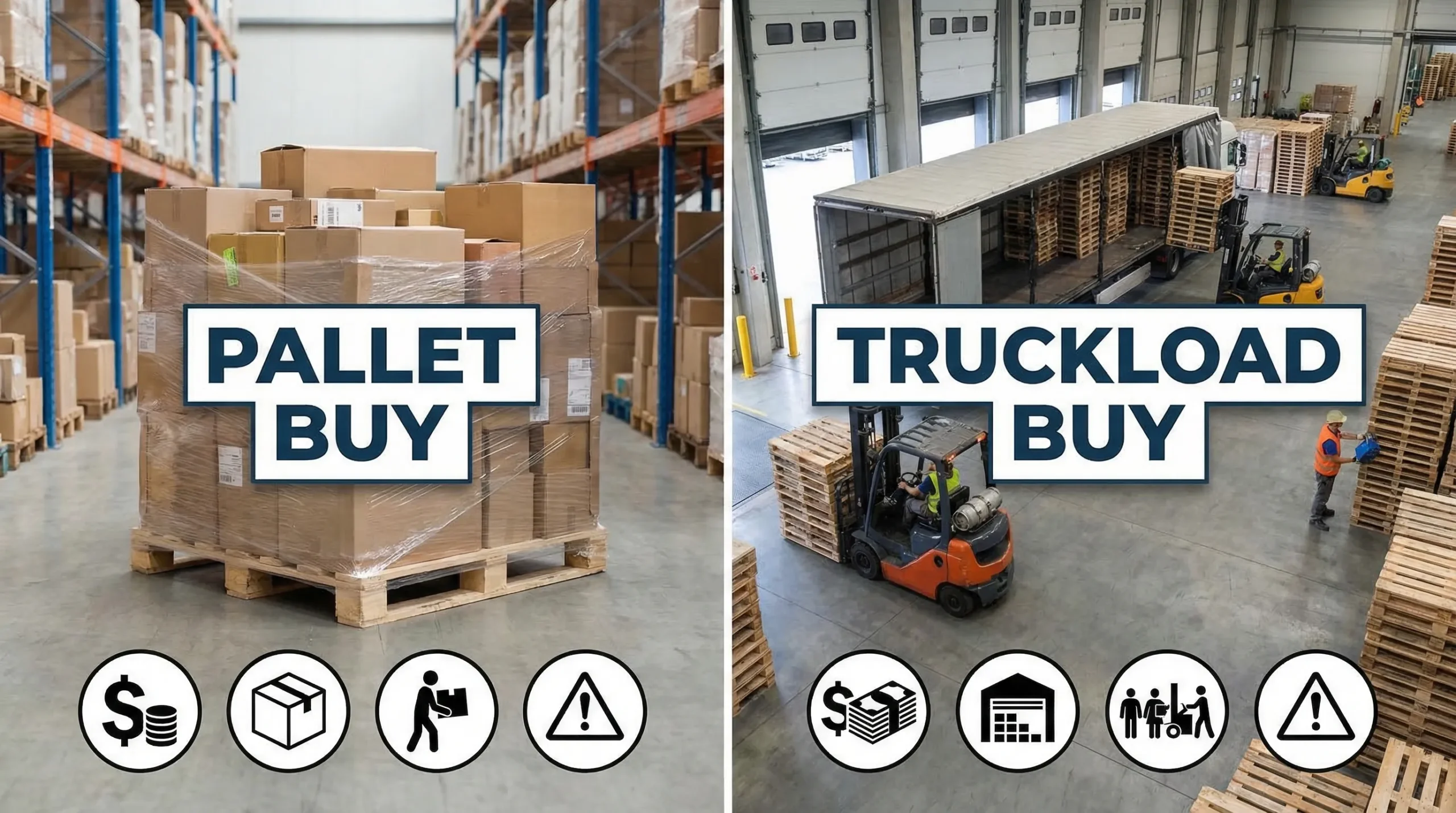
A simple decision framework (the 6 questions that matter)
Instead of guessing, answer these questions honestly. Your best choice usually becomes obvious.
1) How much cash can you risk without needing it back next week?
If you need fast turnover to pay bills, start with pallets. Truckloads can be profitable, but they can also trap cash in unsorted inventory if processing falls behind.
2) Do you have a real place to put the inventory?
A garage or storage unit can work for a couple pallets if you stay disciplined. Truckloads can overwhelm you quickly if you do not have staging zones for “to test,” “ready to list,” and “to liquidate.”
3) What is your labor plan?
Pallet scale can be done solo with weekends and a basic workflow. Truckload scale usually needs repeatable roles (receiving, testing, cleaning, listing, packing, disposal).
4) What is your strongest selling lane?
If you sell locally (flea market, swap meet, Facebook), pallets often match your demand better.
If you have proven online demand plus local outlets (warehouse days, bin-style liquidation, wholesale to smaller resellers), truckloads can make more sense.
5) Can you handle the category risk?
Some categories create more returns, testing, and compliance issues. If your workflow is still developing, avoid stacking complexity. Build wins with categories you can process reliably.
For example, electronics can be profitable but require disciplined testing and clear grading. If that’s your lane, review what to buy and what to avoid in liquidation electronics to reduce the most common loss scenarios.
6) Are you prepared for freight and receiving realities?
With pallets, one bad delivery experience is annoying. With truckloads, receiving mistakes can destroy margins.
If you’re relocating inventory, opening a small warehouse, or moving pallets between facilities, working with a reliable logistics partner can reduce downtime. For resellers in California who need help moving business inventory, consider a trusted moving service like Zapt Movers for local or long-distance moves.
Profit math: how pallets and truckloads change the numbers
Your profit is not “buy price vs resale value.” It is recovery minus landed costs minus operating costs.
Below is a simplified example to show how the structure changes. These are not promises, just a way to model your own deals.
| Metric | Example pallet buy | Example truckload buy |
|---|---|---|
| Inventory cost | $1,200 | $18,000 |
| Freight and delivery | $350 | $2,200 |
| Supplies, disposal, misc. | $75 | $600 |
| Estimated total landed cost | $1,625 | $20,800 |
| Target gross recovery (sales) | $2,600 | $33,000 |
| Gross margin (before labor, fees, overhead) | $975 | $12,200 |
Two key takeaways:
First, truckloads can produce more gross dollars, but only if your sell-through and processing speed keep pace.
Second, pallets can produce smaller gross dollars, but they can be better for learning because you can measure results and adjust without betting the business.
If you want to go deeper on the “real numbers,” including permits, overhead, and break-even thinking, this guide to liquidation business costs and profit math is a strong companion read.
How to reduce risk on both pallets and truckloads
Most reseller losses come from predictable mistakes. The fix is not complicated, it is consistent.
Use manifests the right way
A manifest can help you estimate value, but it is not a guarantee of condition, completeness, or actual sellable quantity. Use it to:
- Spot restricted or risky items for your channel
- Estimate average selling price ranges by category
- Plan your processing time (testing, cleaning, bundling)
Plan a “three-lane” exit strategy
Before you buy, decide where items will go:
- Retail-ready sales (your best channel with highest return)
- Quick-turn sales (bundle, discount, local lots)
- Liquidate or dispose (unsellable, incomplete, restricted)
This is what keeps your warehouse from turning into dead inventory.
Ask the questions that protect your margins
When you’re comparing lots, the smartest move is a repeatable checklist. If you want a ready-made set of questions to use with any supplier, use this pallet store buyer’s guide to reduce surprises.
So which should you choose in 2026?
Choose Amazon liquidation pallets if you want a controlled way to learn, you’re building your workflow, or you’re still validating your best-selling categories.
Choose Amazon liquidation truckloads if you already have reliable sell-through, you can process quickly, and you have the space and cash flow to absorb variability without stalling operations.
If you’re stuck between the two, a smart middle step is often “multiple pallets” (a larger order that is still manageable). It lets you test volume and freight without committing to a full trailer.
Frequently Asked Questions
Is Amazon bulk liquidation better as pallets or truckloads? It depends on your business stage. Pallets are usually better for learning and controlling risk. Truckloads can be better for scaling once you have space, labor, and proven sell-through.
Do truckloads always have better profit margins than pallets? Not always. Truckloads can improve unit economics, but they also increase operational risk. If processing slows down or the lot mix is wrong for your channels, margins can shrink fast.
What should I look for in an Amazon liquidation manifest? Focus on category mix, estimated retail values (as a rough guide), duplicates, and red flags like restricted items for your selling platform. Remember a manifest usually does not guarantee condition.
How much space do I need for a truckload? Enough to receive, stage, and sort without stacking chaos. You need room for at least three zones (incoming, processing, outbound), plus space for unsellables and packaging supplies.
What is the safest way to start with Amazon liquidation inventory? Start with one pallet (or a small set of pallets), track your true landed cost, measure recovery, and refine your workflow. Then scale volume only after you can predict your results.
Source Amazon bulk liquidation with a supplier built for resellers
If you’re ready to buy pallets now, or you’re planning the jump to truckload volume, American Bulk Pallets offers wholesale liquidation pallets and direct truckload sourcing with product manifests, nationwide shipping, international shipping options, and dedicated support for resellers.
Explore inventory and learn what to buy next at American Bulk Pallets, and use this guide on Amazon pallets, conditions, manifests, and margins to evaluate lots before you place an order.