Searching for “liquidation pallets near me” is a smart move if you want to save on freight and inspect inventory in person. It is also one of the easiest ways to get scammed.
In 2026, liquidation fraud is more polished than ever: fake warehouse addresses, copied business names, “too good to be true” manifests, and payment requests that leave you with zero protection. The good news is you can avoid most scams with a repeatable vetting process.
This guide breaks down the most common liquidation pallet scams, the red flags to watch for, and a practical checklist for buying locally (or getting pallets delivered) without getting burned.
Why “near me” liquidation searches attract scammers
Local-intent searches signal high buyer urgency. Scammers know that when you need inventory fast, you might skip due diligence.
“Near me” scams usually follow one of these patterns:
- The seller claims a nearby warehouse, but it is a mailbox, a shared industrial park office, or a completely unrelated address.
- The seller posts photos of pallets they do not own (often stolen from legitimate wholesalers).
- The seller pressures you into a deposit, then disappears or “reschedules pickup” indefinitely.
Legitimate liquidation suppliers can absolutely be local, but they are usually easy to verify because they have consistent paperwork, clear terms, and a traceable business footprint.
The most common liquidation pallet scams (and how they work)
1) The “deposit to hold your pallets” scam
You are told the load will sell today unless you pay a deposit immediately (Zelle, Cash App, wire, crypto). After payment:
- The seller ghosts you
- The seller delays repeatedly
- The seller invents a “delivery fee” or “dock fee” to get more money
How to avoid it: do not pay non-refundable deposits to unverified sellers, especially via irreversible methods.
2) Fake manifests (or manifests that do not match the lot)
A manifest is helpful, but it is also easy to fabricate. Scammers will show a manifest with high retail value items, then deliver (or offer pickup of) mixed low-value goods.
How to avoid it: verify the lot ID, ask how the manifest was generated, and require the manifest to match the exact load you are buying (not a “sample manifest”).
For a deeper primer on what manifests can and cannot tell you, read: Amazon Pallets Explained: Conditions, Manifests, and Margins.
3) The “warehouse address” bait-and-switch
You get an address near you, but when you arrive, the seller tries to move you to a different location, meet in a parking lot, or send a third party.
How to avoid it: confirm the address in writing, verify it on Google Maps, and only pay after you confirm the inventory is physically present.
4) Misrepresented condition (returns vs salvage)
Some sellers label everything as “new” or “like new,” even when the load is mostly customer returns, damaged packaging, missing parts, or salvage.
How to avoid it: require clear condition language (returns, shelf-pulls, overstock, salvage) and match your pricing to the labor required to process the goods.
If you want a structured set of questions to ask any seller, use: Pallets Store Guide: What to Ask Before You Buy.
5) Shipping and “freight broker” scams
A scammer may collect payment for “freight delivery,” then provide a fake tracking number, or they may pose as a broker and never dispatch a carrier.
How to avoid it: verify the carrier and broker identities before dispatch and require a real Bill of Lading (BOL). For U.S. shipments, you can cross-check carrier/broker registration via the FMCSA database.
A quick legitimacy scorecard (green flags vs red flags)
Use this table as a fast gut-check before you send money or drive to a pickup.
| Checkpoint | Green flags | Red flags |
|---|---|---|
| Business identity | Legal business name, physical address, consistent phone/email | No full business name, only DMs, frequent number changes |
| Inventory proof | Timestamped video, matching lot ID, warehouse walkthrough | Stock photos, blurry images, refuses live video |
| Paperwork | Invoice/receipt, clear terms, manifests tied to lot | “No paperwork,” “manifest later,” vague descriptions |
| Payment | Credit card, invoice-based ACH, other traceable options | Wire to personal name, Zelle/Cash App only, crypto only |
| Pickup process | Scheduled appointment, dock access, load confirmation | Parking lot meetups, last-minute location changes |
| Pricing | Within realistic recovery range | Extreme discounts with pressure tactics |
Step-by-step: How to vet “liquidation pallets near me” suppliers
Step 1: Verify the business exists (beyond social media)
A Facebook page is not verification. Look for a footprint that is hard to fake.
What to check:
- State business registration (Secretary of State site for the seller’s state)
- A matching address and phone across listings, invoices, and the website
- Reviews that are specific (what was bought, how it arrived), not generic
A helpful mindset: legitimate local businesses in any industry tend to publish clear service areas, contact details, and consistent branding. For example, service companies like TapTech’s licensed plumbing and drain cleaning team clearly show who they are and where they operate. Liquidation sellers should be similarly transparent.
Step 2: Confirm there is real inventory you can see
Ask for proof that ties the seller to the inventory.
Best proof requests:
- A short live video call showing the pallets and the facility
- A paper or screen showing the lot ID/date in the same frame
- Multiple angles that show scale (dock doors, pallet counts)
If a seller refuses any of these, treat it as a stop sign.
Step 3: Match your buying plan to the seller’s lot type
A lot can be legitimate and still be a bad buy for your business model.
Before you buy, align on:
- Your target resale channel (Amazon/eBay, local marketplace, flea market, bin store, wholesale)
- Your processing capacity (testing, cleaning, parts replacement)
- Your tolerance for salvage
If you are still building your fundamentals (costs, permits, and margin math), this guide helps: Liquidation Business Basics: Costs, Permits, and Profit Math.
Step 4: Ask the questions that expose scams
Instead of asking “Is this a good pallet?”, ask questions that require specifics.
Examples:
- “What retailer(s) is this load from, and how is it sourced?”
- “What condition mix should I expect (returns, overstock, salvage)?”
- “Is there a manifest for this exact lot, and what are the terms if it is materially wrong?”
- “Can you provide an invoice with your business name and address?”
- “What are the pickup rules, loading method, and appointment process?”
For a full checklist built for resellers, see: Wholesale Pallet Sales Near Me: How to Compare Suppliers.
Step 5: Use safe payment and documentation (protect your downside)
Scams get easier when there is no paper trail.
Use documentation that makes disputes possible:
- An invoice with seller’s legal name, address, date, and lot description
- A written description of the condition terms (returns, salvage, etc.)
- For freight, a Bill of Lading (BOL)
Here is a simple risk table for payment methods (general guidance, not legal advice):
| Payment method | Buyer protection level | Best use case |
|---|---|---|
| Credit card | Higher | Smaller test orders, deposits with clear terms |
| Invoice-based ACH to a business account | Medium | Established suppliers with strong paperwork |
| Cash (in person) | Low | Only after you verify inventory and receive a receipt |
| Wire, Zelle, Cash App, crypto | Very low | Avoid for new or unverified sellers |
Local pickup vs freight delivery: scam risks change, but they do not disappear
Buying “near me” often implies local pickup, but many resellers search this term simply because they want fast, affordable inventory, even if it is delivered.
- Pickup lowers freight surprises and lets you inspect some pallets.
- Freight delivery can expand your sourcing options beyond your metro area.
If you are deciding between the two, this breakdown will help you choose based on your stage and budget: Liquidations Near Me: Pickup vs Freight Delivered Pallets.
What to do at pickup (a practical inspection routine)
Do not overcomplicate this. You are trying to confirm the lot is real and roughly consistent with what you bought.
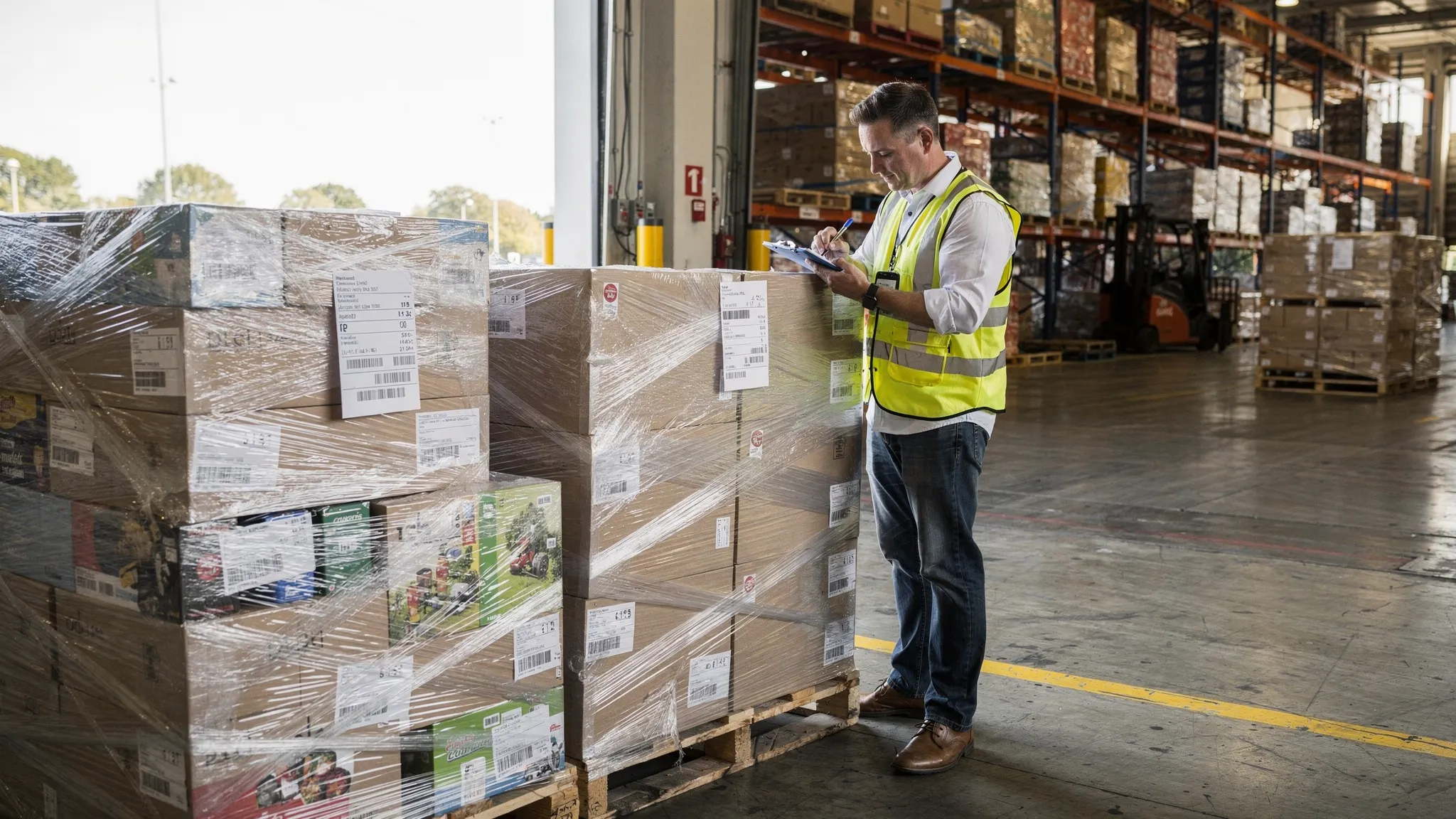
Focus on:
- Count and consistency: are the number of pallets and general categories consistent with the listing?
- Condition signals: excessive breakage, water damage, crushed cartons, loose items
- Labeling: look for mixed retailer labels if the seller claimed single-source
- Loading process: a legitimate warehouse can load safely with a forklift and has a defined process
If the seller rushes you, refuses basic viewing, or changes terms on-site, walk away.
What to do on freight delivery (to avoid “it arrived damaged” disputes)
Freight issues are not always scams, but scammers use freight complexity to hide.
Best practices:
- Confirm whether it is dock delivery, liftgate, or appointment delivery (and the fees)
- Inspect for obvious damage before signing
- Take photos of the shipment as it arrives
- Keep all paperwork (BOL, delivery receipt)
If you want a more detailed safety process for large orders, read: American Liquidations: How to Buy Truckloads Safely.
A simple “too good to be true” pricing reality check
You do not need perfect math to avoid bad buys, you just need a sanity check.
Ask yourself:
- If this were truly a high-value load at a massive discount, why would it be sold to a random buyer today?
- Does the expected recovery (what you can realistically sell) cover your landed cost (inventory + freight + labor + fees + disposal)?
If you rely heavily on manifests, treat them as an estimate, not a guarantee. The more return-heavy the lot, the more variance you should expect.
What to do if you suspect fraud
If you think you have been scammed, act quickly.
- Contact your payment provider immediately (chargeback or ACH dispute options vary)
- Save screenshots, invoices, texts, emails, and listings
- Report to the FTC if it is a consumer-facing fraud pattern
- File a complaint with the FBI Internet Crime Complaint Center (IC3) for online payment scams
- Consider reporting to your state Attorney General if the seller claimed to operate in your state
Even if you do not recover funds, reporting helps platforms and investigators connect patterns.
Safer alternatives when “near me” inventory is sketchy
Sometimes the safest move is to expand your definition of “near me.” If local listings are full of red flags, buying from an established liquidation pallet supplier that ships nationwide can reduce risk because you can get consistent paperwork, manifests tied to lots, and support.
American Bulk Pallets sources wholesale liquidation pallets and direct truckload liquidations and ships nationwide (with international shipping available). You can browse current availability and request details here: American Bulk Pallets wholesale liquidation inventory.
Frequently Asked Questions
Is it safer to buy liquidation pallets locally? Local pickup can be safer because you can verify the inventory exists and inspect condition signals, but local scams are common. Vet the seller and use protected payment methods.
What is the biggest red flag when buying liquidation pallets near me? Pressure to pay a deposit via irreversible payments (wire, Zelle, Cash App, crypto) before you verify the business and inventory.
Are manifests always accurate? No. Manifests can be incomplete or wrong, especially for return-heavy loads. Treat manifests as guidance and price for variance.
How do I verify a liquidation pallet supplier is legitimate? Check business registration, consistent contact info, real inventory proof (live video), paperwork (invoice/BOL), and a clear pickup or shipping process.
What payment method should I use for a first order? When possible, use a method with buyer protection (often credit card for smaller test orders) and always require an invoice and written terms.
Buy liquidation pallets with less risk
If you are comparing options for liquidation pallets near me, start with a small test order, require manifests and paperwork, and use a repeatable vetting checklist. When you are ready to scale beyond local listings, explore nationwide supply options with documented sourcing and shipping support.
Browse available loads and request details from American Bulk Pallets: americanbulkpallets.com.