
Buying Amazon pallets returns can be profitable, but only if you understand one phrase that gets thrown around loosely: “customer return.” Many new buyers assume it means “basically new” inventory. In reality, “customer return” describes how the item came back into the supply chain, not whether it is sellable, complete, or even safe to ship.
This guide breaks down what “customer return” really means in liquidation, what conditions you should expect inside Amazon return pallets, and how resellers can evaluate risk before spending on a pallet or a truckload.
What “customer return” really means (and what it does not)
In liquidation listings, customer return typically means the unit was purchased by a consumer and then returned through a retailer’s returns process (in this case, Amazon or an Amazon seller). After that return, the item may be:
- Routed back to sellable inventory (if it passes inspection)
- Sent to a secondary channel (warehouse deals, refurb, resale)
- Consolidated into liquidation lots (pallets or truckloads)
What it does not guarantee:
- The item is unused
- The item works
- The item has all parts, manuals, or accessories
- The box is intact
- The item is eligible for resale on every marketplace
A helpful mindset is: “Customer return” is a source label, not a condition grade.
Why customers return items (and why it matters to your margins)
Returns are common in eCommerce, and not every return is a problem. The reason for the return heavily influences your expected recovery rate.
Industry-wide, returns are a massive operational cost. The National Retail Federation (NRF) and Appriss Retail have estimated U.S. retail returns in the hundreds of billions of dollars annually (for example, their annual returns reports have put recent totals above $700B). That scale is one reason retailers aggressively sort and route returns, and why the “leftovers” end up in liquidation.
From a reseller perspective, return reasons fall into two buckets:
Lower-risk return reasons (often good for resale)
- Buyer changed their mind
- Wrong size/color (common in apparel)
- Duplicate order
- Shipping delay
- Box opened but item unused
Higher-risk return reasons (often labor-heavy)
- “Doesn’t work” (could be user error or a real defect)
- Missing parts
- Used beyond a quick test
- Damage in transit
- Suspected counterfeit or swapped item (higher risk in certain categories)
You usually will not get verified return reasons item-by-item in a liquidation pallet. That uncertainty is why process and pricing discipline matters more than “estimated retail value.”
What you can expect inside Amazon customer return pallets
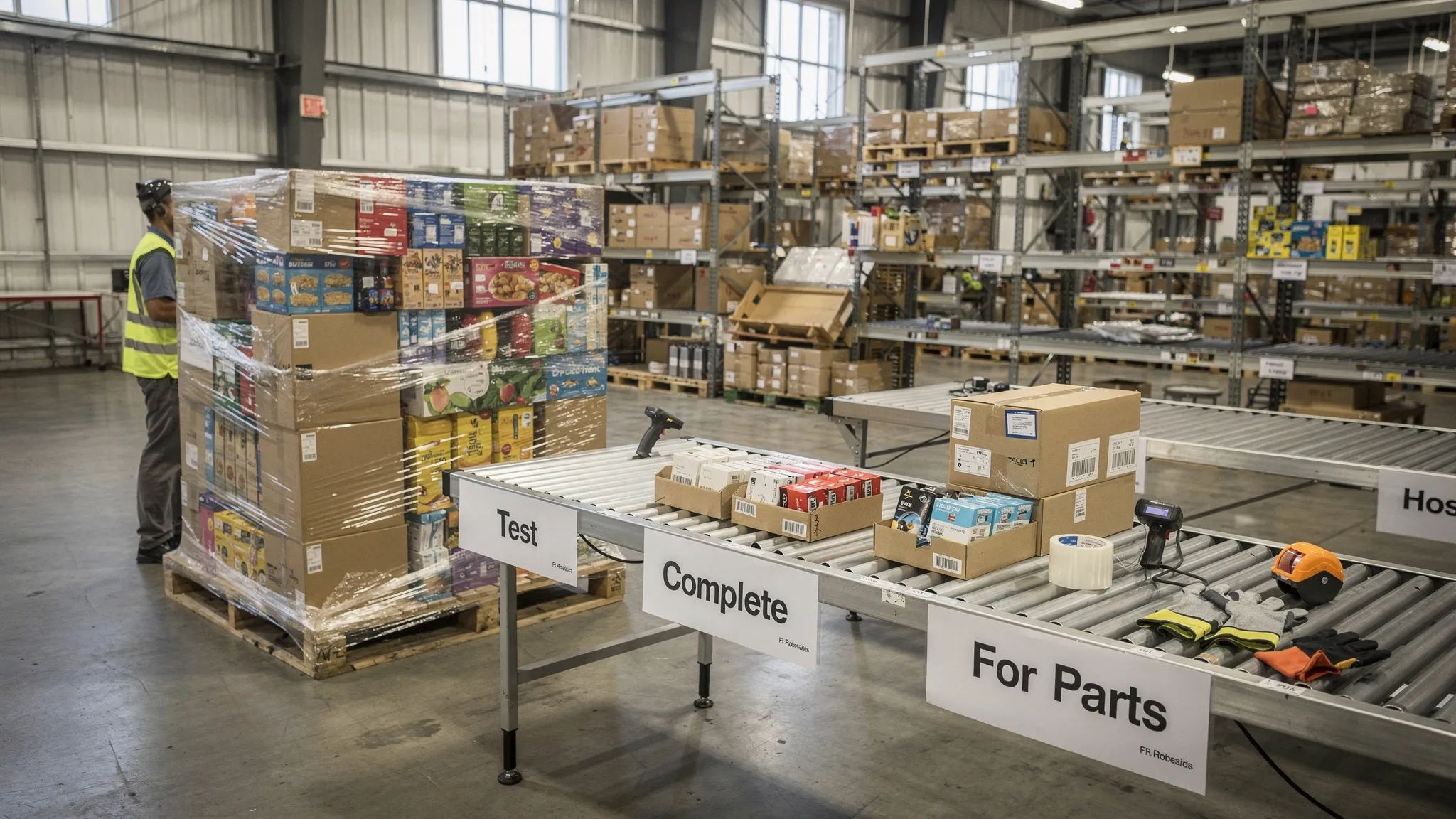
A single customer return pallet can contain a mix of conditions. Even if a lot is marketed as “returns,” your actual contents commonly include:
- New or like-new items in opened packaging
n- Lightly used items - Items missing accessories (chargers, remotes, mounting kits)
- Items with cosmetic wear
- Items that require testing (especially electronics)
- Items that are uneconomical to process (low ASP, high labor)
Quick interpretation table: “customer return” condition outcomes
| What you find in a customer return pallet | What it usually means | Impact on resale plan |
|---|---|---|
| Factory-sealed item | Returned unopened or reshelved incorrectly | Often your fastest flip if authentic and unrestricted |
| Open box, looks new | Opened for inspection or buyer remorse | Great for “open-box” listing lanes |
| Open box, missing accessories | Typical in returns consolidation | Margin depends on replacement part cost and time |
| Visible wear or signs of use | Item was actually used | Price lower, increase return risk, choose the right marketplace |
| “No power / not working” | Could be defect, wrong adapter, or damage | Only buy if you have test workflow and a parts lane |
| Damaged packaging only | Common in returns | Often still sellable locally or as “new other” depending on policy |
Manifests: useful, but not a promise
Manifests can be a major advantage when buying Amazon pallets returns, but only if you read them like a reseller, not like a treasure map.
A manifest is typically best for:
- Category mix (how much is electronics vs home goods vs toys)
- SKU concentration (do you have 1,000 unique items or repeatables)
- Average selling price estimates (for planning, not certainty)
- Flagging risk items (hazmat, high-fraud categories, heavy/bulky)
A manifest is typically not reliable for:
- Exact condition per unit
- Completeness (accessories, manuals, hardware)
- Functionality
- Marketplace eligibility
If you want a deeper dive on how resellers use condition, manifests, and margin math together, this companion guide is worth reading: Amazon pallets explained: conditions, manifests, and margins.
The smartest workflow for customer return pallets (so you do not drown in labor)
Customer returns become profitable when you control processing time. Most successful buyers run a simple triage system designed to push items into the right “exit lane” quickly.
A practical 3-lane triage system
Lane 1: Ready to list
These are complete items that pass a quick check.
Lane 2: Needs work
Missing parts, needs cleaning, needs testing, or needs repackaging.
Lane 3: Parts / salvage / bundle
Items that are not worth individual processing but can still recover value.
Minimal receiving checklist (keep it repeatable)
- Photograph the pallet as delivered (before and after opening)
- Compare pallet count and labels to the paperwork
- Do a fast safety screen (broken glass, leaking liquids, swollen batteries)
- Sort first, test second (sorting prevents “one item” from stealing an hour)
- Track outcomes (a simple spreadsheet is enough at the start)
If you are buying larger lots, you may also want to plan for basic compliance steps, especially in categories like electronics, toys, cosmetics, and anything battery-powered. Some scaling teams use an AI compliance workflow platform to help document policies, remediation actions, and repeatable checks as their volume grows.
Common “customer return” surprises (and how to plan for them)
Missing accessories and “incomplete sets”
This is the most common margin killer. A $120 item becomes a $25 problem if a proprietary charger or mounting bracket is missing.
How to reduce the hit:
- Prefer lots with repeat SKUs so you can build a parts bin
- Stock common accessories (charging cables, AA/AAA packs, universal mounts)
- Bundle incomplete items (two incomplete units can make one complete sale)
Electronics testing and data risk
Returns electronics often need more than “it turns on.” For resale, your workflow may require:
- Basic functional test
- Battery health check when relevant
- Factory reset
- Data wipe steps for devices with storage
If you mainly sell in-person (flea markets, bin stores, local warehouse sales), your testing burden might be lighter than if you sell on marketplaces with stricter return expectations.
Restricted, recalled, or hazmat items
Some items are costly or impossible to resell via certain channels due to safety rules, hazmat rules, or brand restrictions.
Practical tip: before you buy, decide your plan for:
- Lithium batteries (shipping constraints)
- Aerosols and chemicals
- Items with known recalls (check the CPSC recall database)
How to price Amazon customer return pallets without getting burned
Instead of pricing a pallet based on “total retail,” price it based on recoverable value and your real costs.
A simple reseller rule that works well for customer returns:
Max Buy Price = (Expected Recovery Revenue × Target Margin) − Landed Costs
Where landed costs include:
- Freight to your dock
- Labor to sort and test
- Marketplace fees
- Packaging and returns allowance
- Disposal or recycling for unsellables
If you are still deciding whether pallets or truckloads fit your cash flow and storage, compare them here: Amazon bulk liquidation: pallets vs truckloads for resellers.
Questions to ask before buying “customer return” pallets
Sellers and listings use similar words, but the details change everything. Before purchasing, get clarity on:
- Are these customer returns only, or a mix (overstock, shelf pulls, salvage)?
- Is a manifest provided and how detailed is it?
- Are pallets sold as-is, and what is the policy on major mismatches?
- Are there category exclusions (hazmat removed, high-value removed)?
- What is the shipping method, delivery appointment process, and expected timeline?
If you want a broader buyer checklist you can reuse for any retailer pallets, save this guide: Pallets store guide: what to ask before you buy.
Frequently Asked Questions
Are Amazon customer return pallets mostly new items? Customer returns often include some like-new items, but you should expect a mix. “Customer return” describes the source, not the condition.
What is the biggest risk with Amazon pallets returns? Labor and uncertainty. Missing parts, non-working electronics, and category restrictions can erase profit if you do not have a fast triage workflow.
Do manifests guarantee what I will receive? No. Manifests are planning tools, not warranties. They help you estimate category mix and value, but they rarely confirm condition or completeness.
What should beginners buy if they want to start with customer returns? Start with categories you can inspect quickly (home goods, small appliances, some tools) and avoid high-testing categories until you have a process.
Is it better to buy pallets or truckloads for Amazon returns? Pallets reduce cash and operational risk for newer resellers. Truckloads can improve unit economics, but only if you have space, labor, and multiple sales lanes.
Source Amazon return pallets with a clearer plan
“Customer return” can be a great inventory source when you buy with realistic expectations, a sorting workflow, and pricing based on recoverable value, not retail hype.
If you are looking for wholesale liquidation pallets or larger volume lots with manifests and shipping support, explore American Bulk Pallets: American Bulk Pallets. You can also build your knowledge base with the site’s Amazon-specific guides, including Amazon liquidation pallets explained, before you place your next bulk order.